

Protein shopping can become expensive long before it becomes useful. Tubs of powder, premium bars, and oversized meat portions may look like the price of serious training, yet the body does not reward a higher grocery bill. What matters most is reaching a sensible daily intake with foods that fit your training and diet. The challenge is buying enough protein without paying for amounts or features you do not need.
Start With Enough, Not as Much as Possible
For most healthy men who exercise regularly, a useful protein range is 1.4–2.0 grams per kilogram of body weight per day. The lower-to-middle part of that range is often enough. Across resistance-training studies, the average extra benefit for muscle gain becomes small at roughly 1.5–1.6 g/kg/day, although this is a population estimate rather than a hard biological ceiling [1], [2], [3].
For an 80-kilogram man, 1.4–1.6 g/kg is about 112–128 grams a day, a more economical starting point than automatically aiming for the top of the range. Moving upward may make sense during a deliberate energy deficit or demanding training phase, but very high intakes are not a rule for every recreational trainee [3].
Protein offers modest additional gains when it accompanies resistance training; it does not replace progressive overload, adequate energy, or recovery. One dose-response review found a small strength advantage with additional protein and resistance training, but no benefit without training [2].
Before buying anything, record several ordinary days of eating and calculate the gap between your intake and target. Existing meals may already cover most of it, leaving a smaller shortfall than supplement advertising implies.
Compare Equal Amounts of Protein
There is no universal list of the cheapest protein foods. Prices change by country, shop, season, package, and edible yield. Lentils may be excellent value in one place, while eggs, milk, tofu, canned fish, or poultry wins elsewhere. Composition data cannot establish value in your local store [8].
The most useful comparison is cost per fixed amount of protein. For 25 grams, use this calculation:
Cost per 25 g protein = package price ÷ total protein in the package × 25
Use grams of protein, not total product weight, and account for bones, discarded liquid, cooking loss, and likely waste.
Price per protein serving is a filter, not the entire decision. Compare calories, fiber, micronutrients, saturated fat, sodium, preparation time, storage, and taste. A food you dislike or cannot digest is not economical if it sits unused. Likewise, the lowest-cost protein source may be a poor foundation for the whole diet if it crowds out fruit, vegetables, varied fats, or carbohydrate needed for training.
Build Around Ordinary Protein Anchors
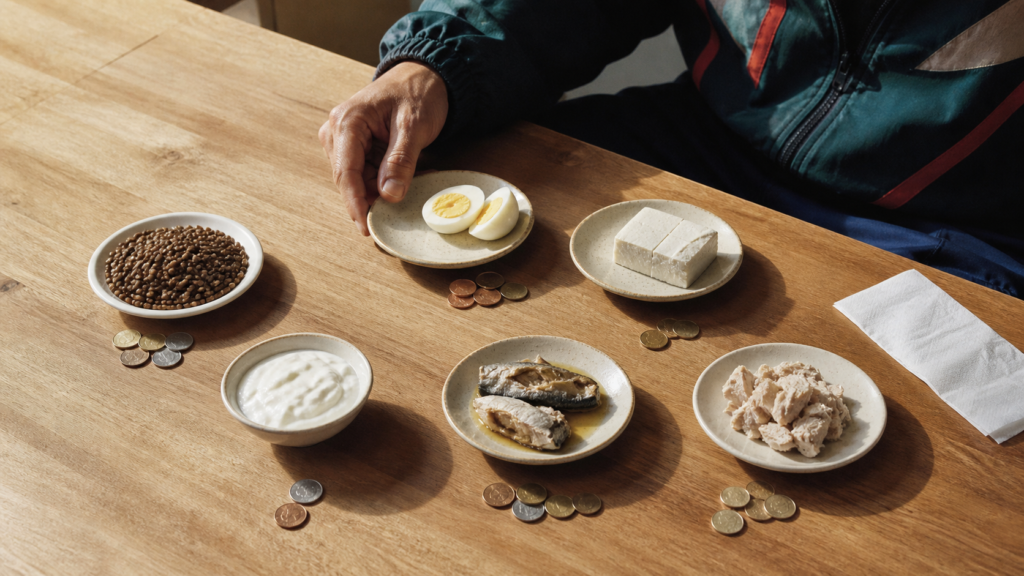
Choose several dependable foods rather than one perfect option. Beans, lentils, peas, textured vegetable protein, tofu, eggs, milk, plain yogurt, canned fish, and less expensive poultry cuts are candidates to test locally—not a scientific price ranking [3], [8].
Pulses deliver protein and fiber, though they require more volume and may take preparation. Dairy, eggs, soy, fish, and meat provide essential amino acids in compact servings. Canned foods save time but may be higher in sodium. Batch cooking lowers effort if storage and reheating are safe.
Protein powder belongs in the same comparison. It is a convenience food, not a superior muscle-building category. A basic whey or soy powder can be worthwhile when it is tolerated, costs less per 25 grams than suitable foods, and closes a measured shortfall. If ordinary meals already meet your target, a shake adds expense without a special effect. Blends, “mass gainers,” and added ingredients are not necessary for the protein itself [3].
Plant Protein Can Do the Job
Reviews of randomized trials find no meaningful strength difference between plant and animal protein. Some pooled results show a small lean-mass advantage for animal protein, but soy and milk perform similarly for muscle mass; the apparent disadvantage is concentrated mainly in limited non-soy comparisons [4], [5]. Many studies use isolates rather than everyday meals.
Total protein, sufficient energy, and amino-acid variety matter more than paying extra for animal protein solely for strength. Soy has the strongest comparative evidence among plant sources. Other legumes, grains, nuts, and seeds can contribute across the day; complementary proteins need not meet in the same mouthful [4], [5].
Men eating exclusively plant-based diets should pay closer attention to total intake and variety because some plant foods are less digestible and contain less leucine per gram. Increasing pulses gradually can also reduce gastrointestinal discomfort. These are reasons to plan, not reasons to dismiss a budget-friendly plant-based approach.
Spread Meals Without Watching the Clock
Daily intake deserves the first share of the budget. Protein in three or four convenient meals can make the target easier to reach. Guidance commonly suggests 20–40 grams per meal, or roughly 0.25 g/kg, every three to four hours [3].
That precision is optional. Evidence that even distribution improves long-term strength or growth remains limited. Acute muscle protein synthesis is not proof of additional muscle gained over months [6].
The same caution applies to the supposed need for an immediate post-workout shake. Once total protein is considered, research does not establish a narrow “anabolic window” that requires buying protein within minutes of the last set [7]. A normal protein-containing meal reasonably near training is usually sufficient. Timing may still be a useful refinement, but it should not force an unnecessary purchase or a meal that causes digestive discomfort.

Protect Training Fuel and Diet Quality
Once protein is sufficient, more may displace other useful foods. This matters for endurance athletes and men doing high-volume mixed training: protein helps repair, but carbohydrate remains the priority for fueling endurance work [3].
Spend the remaining budget on adequate total energy, carbohydrate-rich staples, fruit, vegetables, and varied fats rather than chasing a higher protein number. Persistent fatigue, falling performance, or unintentional weight loss can be signs that total fuel—not protein alone—deserves attention. The exact carbohydrate requirement depends on training load, but protein beyond sufficiency cannot rescue chronic under-fueling.
A Practical Budget Method
For healthy recreational lifters and mixed-training athletes, a simple process is enough:
- Start around 1.4–1.6 g/kg/day rather than assuming you need the top of the range.
- Track several normal days and identify the consistent shortfall.
- Compare local foods and powders by cost per 25 grams of actual protein.
- Select a few foods that also fit your energy needs, digestion, schedule, and overall diet.
- Place them across three or four meals if convenient, without paying for stopwatch-perfect timing.
- Reassess when body weight, training volume, or a deliberate dieting phase changes.
The goal is reliable access to enough protein to support the modest additional gains seen alongside effective resistance training. Individual response varies, and the modeled plateau near 1.5–1.6 g/kg is an uncertain average [1], [2].
Higher-protein diets have not produced adverse short- to medium-term changes in kidney function in randomized trials of adults without kidney disease, but those studies do not prove lifetime safety [9]. Men with kidney disease, clinician-directed protein or mineral restrictions, or another relevant medical history should not adopt athlete targets without individualized professional advice. Allergies, lactose intolerance, gastrointestinal tolerance, and sodium in processed foods also deserve ordinary caution.
Conclusion
Eating plenty of protein on a budget is mostly an exercise in setting a sufficient target and comparing like with like. Fund the daily total before timing tricks, choose among locally affordable whole foods, and use powder only when it solves a real gap at a competitive price. The money saved by avoiding unnecessary excess can support the carbohydrate, varied foods, and consistent training that protein alone cannot replace.
Sources
- A systematic review, meta-analysis and meta-regression of the effect of protein supplementation on resistance training-induced gains in muscle mass and strength in healthy adults. British Journal of Sports Medicine. 2018. Direct link. DOI: 10.1136/bjsports-2017-097608.
- Synergistic Effect of Increased Total Protein Intake and Strength Training on Muscle Strength: A Dose-Response Meta-analysis of Randomized Controlled Trials. Sports Medicine – Open. 2022. Direct link. DOI: 10.1186/s40798-022-00508-w. PMID: 36057893.
- International Society of Sports Nutrition Position Stand: protein and exercise. Journal of the International Society of Sports Nutrition. 2017. Direct link. DOI: 10.1186/s12970-017-0177-8. PMID: 28642676.
- Animal Protein versus Plant Protein in Supporting Lean Mass and Muscle Strength: A Systematic Review and Meta-Analysis of Randomized Controlled Trials. Nutrients. 2021. Direct link. DOI: 10.3390/nu13020661.
- Effect of Plant Versus Animal Protein on Muscle Mass, Strength, Physical Performance, and Sarcopenia: A Systematic Review and Meta-analysis of Randomized Controlled Trials. Nutrition Reviews. 2025. Direct link. DOI: 10.1093/nutrit/nuae200. PMID: 39813010.
- Evenness of dietary protein distribution is associated with higher muscle mass but not muscle strength or protein turnover in healthy adults: a systematic review. European Journal of Nutrition. 2021. Direct link. DOI: 10.1007/s00394-021-02487-2. PMID: 33550490.
- The effect of protein timing on muscle strength and hypertrophy: a meta-analysis. Journal of the International Society of Sports Nutrition. 2013. Direct link. DOI: 10.1186/1550-2783-10-53.
- FoodData Central. U.S. Department of Agriculture, Agricultural Research Service. Continuously updated; accessed 2026. Direct link.
- Changes in Kidney Function Do Not Differ between Healthy Adults Consuming Higher- Compared with Lower- or Normal-Protein Diets: A Systematic Review and Meta-Analysis. The Journal of Nutrition. 2018. Direct link. DOI: 10.1093/jn/nxy197. PMID: 30383278.