Author: Helidform

  • Can You Lose Fat Only Around the Belly?

    Can You Lose Fat Only Around the Belly?

    You can finish a hard abdominal session with a deep burn, a tight midsection, and the sense that you have attacked belly fat directly. The muscles worked, but the fat above them received no special instruction to disappear. That distinction leads to a better plan: train the abdomen for strength and development, while using nutrition, aerobic activity, and full-body resistance training to reduce fat overall.

    Why Spot Reduction Is So Convincing—and So Misleading

    The idea behind spot reduction sounds reasonable. A working muscle needs energy, and researchers can detect short-term fat mobilization near active tissue. This release of stored fat is called lipolysis. But a temporary local response is not a lasting reduction in that fat depot.

    Long-term training studies are what matter. A meta-analysis of 13 controlled studies, covering 1,158 people and an average intervention of 11 weeks, compared trained and untrained regions. The difference in fat loss was trivial and not statistically significant. Most comparisons involved limbs, not the abdomen, but the design controlled for each person’s diet and biology. The trained region still did not lose meaningfully more fat [1].

    A small randomized trial tested abdominal training directly. Twenty-four sedentary adults performed seven abdominal exercises, five days a week for six weeks. Their curl-up endurance improved, showing that the training worked. Yet abdominal fat, waist circumference, and total body fat did not fall [2].

    The practical lesson is not that abdominal exercise is useless. Crunches, carries, rollouts, and similar movements can improve trunk strength, endurance, lifting support, and muscular development. Building the abdominal muscles may also change how the torso looks. What these exercises cannot reliably do is choose where the body draws down its stored fat.
    Belly Fat Is Not One Thing

    The soft layer you can pinch around the waist is subcutaneous fat. Visceral fat sits deeper, around the internal organs. These two compartments are measured differently and may not respond in exactly the same way.

    This matters because the mirror, the tape measure, and the bathroom scale each show only part of the picture. Waist circumference is practical, but it can shift with measurement technique, gut contents, and abdominal distension. Skinfolds estimate subcutaneous fat but cannot measure visceral fat. DXA can provide regional estimates, while CT and MRI measure abdominal compartments more directly [1], [5].

    Exercise may reduce visceral fat even when scale weight barely changes. Across 40 randomized trials involving 2,190 adults with overweight or obesity, exercise reduced CT- or MRI-measured visceral fat compared with no-exercise controls. Greater exercise energy expenditure was linked with a larger response [5]. In a controlled trial of men with obesity, supervised exercise without weight loss reduced abdominal and visceral fat while cardiorespiratory fitness improved by about 16% [8]. That result shows what is possible under specific research conditions, not what every trainee should expect.

    For everyday tracking, combine body weight with a consistently measured waist, and add performance if strength matters. Follow trends over weeks rather than treating a pump, one weigh-in, or temporary bloating as fat loss.

    What Actually Reduces Abdominal Fat

    You cannot direct fat loss to the belly, but you can reduce it through broader fat loss. That requires a sustainable energy deficit, supported by diet, everyday movement, and planned exercise. The body still decides where fat comes off, and the pattern varies with baseline fatness, age, sex, genetics, adherence, diet, and exercise expenditure [3], [5], [6].

    Aerobic exercise has the clearest dose-response evidence

    A 2024 analysis of 116 randomized trials included 6,880 adults with overweight or obesity. On average, each additional 30 minutes per week of supervised aerobic exercise was associated with 0.56 cm less waist circumference, along with small reductions in visceral and abdominal subcutaneous fat. Effects generally grew as weekly exercise approached 300 minutes. Average changes considered clinically important in waist and body fat usually appeared at 150 minutes or more of moderate-to-vigorous exercise per week [3].

    These are group averages, not a formula: 150 minutes is not a switch that turns belly-fat loss on. The evidence also comes mainly from supervised programs in adults with overweight or obesity, not lean, highly trained men.

    Choose a cardio mode you can repeat and recover from. Brisk walking, cycling, running, intervals, and other sufficiently demanding activities can all add meaningful energy expenditure. High-intensity interval training may be time-efficient or useful for fitness, but it is not clearly superior to continuous moderate-to-vigorous exercise for weight regulation [6]. Joint tolerance, sleep, sport, lower-body lifting, and soreness should influence the choice.

    Resistance training protects what you want to keep

    Full-body resistance training is not a targeted belly-fat treatment. Used alone, however, it can modestly improve body composition while directly building strength. A meta-analysis found average reductions of 1.46 percentage points in body-fat percentage and 0.55 kg in fat mass compared with no exercise, plus a moderate reduction in visceral fat [4]. Protocols and measurement methods varied, so these results do not define a single ideal routine.

    Resistance work becomes especially valuable during dietary weight loss. A 2025 review of 25 randomized trials found that adding it did not meaningfully increase scale-weight loss, but favored greater fat loss, better preservation of fat-free mass, and improved strength [7]. Similar weight loss can therefore produce a different body-composition result.

    There is an important limitation: all participants in that review had overweight or obesity, women were heavily represented, and fat-free mass is not identical to directly measured muscle mass. Even so, for a recreational man who wants a smaller waist without giving up strength, resistance training serves a purpose that scale weight cannot capture.
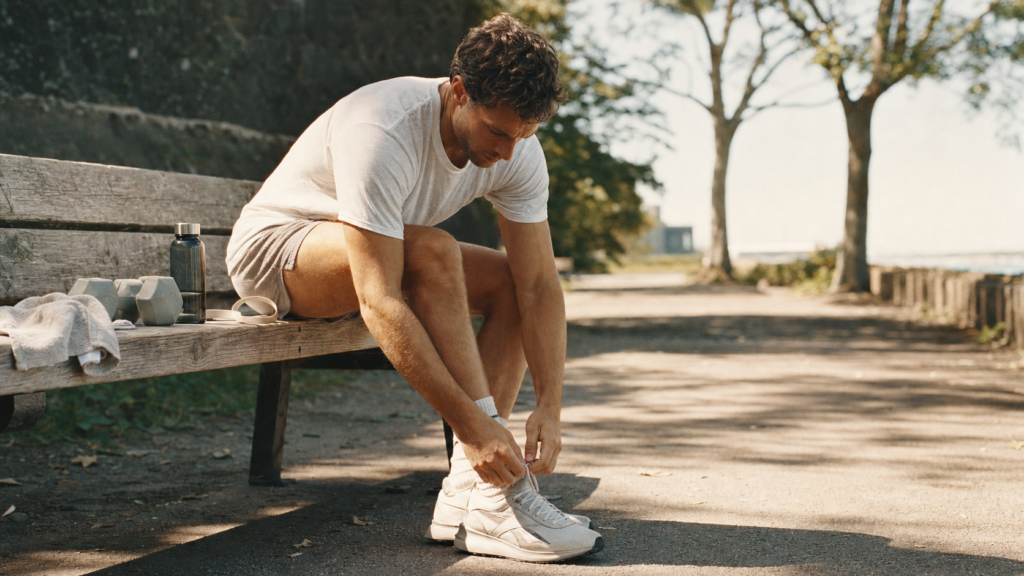
    Man tying his training shoes beside dumbbells on a park bench

    A Practical Plan Without “Fat-Burning” Tricks

    For men carrying excess body fat, the evidence supports a combined approach rather than a special abdominal protocol:

    • Create a manageable energy deficit through food intake, habitual movement, and exercise. Avoid aggressive restriction that undermines training, recovery, or adherence.
    • Keep full-body resistance training in the program to support strength and retain more fat-free mass during weight loss [4], [7].
    • Add aerobic work at a tolerable starting dose. Progressing toward 150 minutes per week of moderate-intensity activity is supported for adults with overweight or obesity, but it is a population guide, not an individual requirement or guarantee [3], [6].
    • Train the abdomen according to functional and muscular goals. Progress the load and volume as you would for other muscles, without expecting preferential fat loss [1], [2].
    • Track waist, body weight, and performance consistently. Judge the direction of change over several weeks, not day to day.

    Already-lean trainees should be especially cautious about borrowing expected results from obesity research. Losing the last visible layer around the waist may require further total fat loss, but the studies here cannot predict the necessary deficit, the speed of change, or whether that tradeoff will support performance and recovery. Individual responses vary substantially.

    More work is not automatically better. Aerobic volume can raise recovery demands, while a harsh diet can make lifting and adherence harder. Start lower if fitness or joint tolerance requires it, then build gradually. Reduce abdominal load or range if it causes pain. Unexplained abdominal enlargement, a suspected hernia, severe pain, dizziness, chest symptoms, or substantial metabolic disease warrants clinical guidance before training or dieting is intensified [1], [6].

    Conclusion

    Abdominal training can build a stronger, more capable midsection, but it cannot reliably select the fat that covers it. Belly fat falls as part of a broader and individually patterned change in body fat, best supported by a sustainable energy deficit, aerobic activity, and resistance training. Measure progress with more than the scale, expect modest rather than perfectly predictable changes, and choose a plan you can train, recover from, and maintain.

    Sources

    1. Ramirez-Campillo R, Andrade DC, Clemente FM, et al. A proposed model to test the hypothesis of exercise-induced localized fat reduction (spot reduction), including a systematic review with meta-analysis. Human Movement. 2022. Full text. DOI: 10.5114/hm.2022.110373.
    2. Vispute SS, Smith JD, LeCheminant JD, Hurley KS. The effect of abdominal exercise on abdominal fat. Journal of Strength and Conditioning Research. 2011. PubMed. DOI: 10.1519/JSC.0b013e3181fb4a46. PMID: 21804427.
    3. Jayedi A, Soltani S, Emadi A, Zargar MS, Najafi A. Aerobic Exercise and Weight Loss in Adults: A Systematic Review and Dose-Response Meta-Analysis. JAMA Network Open. 2024. Full text. DOI: 10.1001/jamanetworkopen.2024.52185. PMID: 39724371.
    4. Wewege MA, Desai I, Honey C, et al. The Effect of Resistance Training in Healthy Adults on Body Fat Percentage, Fat Mass and Visceral Fat: A Systematic Review and Meta-Analysis. Sports Medicine. 2022. PubMed. DOI: 10.1007/s40279-021-01562-2. PMID: 34536199.
    5. Recchia F, Leung CK, Yu AP, et al. Dose-response effects of exercise and caloric restriction on visceral adiposity in overweight and obese adults: a systematic review and meta-analysis of randomised controlled trials. British Journal of Sports Medicine. 2023. Full text. DOI: 10.1136/bjsports-2022-106304.
    6. Jakicic JM, Apovian CM, Barr-Anderson DJ, et al. Physical Activity and Excess Body Weight and Adiposity for Adults: American College of Sports Medicine Consensus Statement. Medicine & Science in Sports & Exercise. 2024. ACSM record. DOI: 10.1249/MSS.0000000000003520. PMID: 39277776.
    7. Binmahfoz A, Dighriri A, Gray C, Gray SR. Effect of resistance exercise on body composition, muscle strength and cardiometabolic health during dietary weight loss in people living with overweight or obesity: a systematic review and meta-analysis. BMJ Open Sport & Exercise Medicine. 2025. Full text. DOI: 10.1136/bmjsem-2024-002363. PMID: 40909191.
    8. Ross R, Dagnone D, Jones PJH, et al. Reduction in obesity and related comorbid conditions after diet-induced weight loss or exercise-induced weight loss in men: a randomized, controlled trial. Annals of Internal Medicine. 2000. PubMed. PMID: 10896648.
  • What Changes When You Walk 10,000 Steps Every Day

    What Changes When You Walk 10,000 Steps Every Day

    Your watch shows 8,700 steps at the end of the day, so you pace around the kitchen to reach 10,000. It feels satisfying, but the number can also imply that 9,999 is failure and 10,000 unlocks a special health effect. The evidence tells a more useful story: the benefit depends on where you start, how you walk, and what else you do. Here is what the target can—and cannot—reasonably do for fitness, body composition, strength, and recovery.

    The Number Is a Target, Not a Threshold

    Ten thousand steps is a practical goal, not a biological cutoff. Health does not suddenly change when the counter rolls from 9,999 to 10,000, and a lower total is not automatically inadequate.

    Large observational studies show that the relationship between steps and health is generally dose-responsive: more movement is associated with lower risk, but the biggest relative gain often comes when someone with a low step count becomes moderately active. In a 2025 analysis, roughly 7,000 steps a day was already associated with meaningful differences across several outcomes. Compared with 2,000 steps, 7,000 was associated with a 47% lower risk of death from any cause and a 25% lower incidence of cardiovascular disease [1]. An earlier analysis found that the mortality association flattened at around 6,000–8,000 steps for adults aged 60 or older and 8,000–10,000 for younger adults [2].

    These studies followed people rather than randomly assigning fixed step counts. They show an association, but cannot prove that walking exactly 7,000 or 10,000 steps caused the entire risk difference. Healthier people may also walk more, and other lifestyle factors may contribute. Young, recreationally trained men are underrepresented.

    The practical message is reassuring: you do not need to worship one number. If you currently average 3,000 steps, consistently reaching 6,000 may matter more than the difference between 9,000 and 10,000. A sustainable increase from your own baseline is the useful part.

    What Changes in Your Heart and Fitness

    During a walk, heart rate and breathing rise, working muscles receive more blood, and energy use increases. Those immediate responses are normal, but they are not the same as becoming fitter. Lasting adaptation requires repeated walking that creates enough of a challenge.

    Across 42 studies of outdoor walking groups, participants improved maximal oxygen uptake—VO2max—by an average of 2.66 mL/kg/min. Resting systolic and diastolic blood pressure fell by averages of 3.72 and 3.14 mm Hg, and functional walking performance improved [4]. The studies varied considerably; many included older adults, women, or people with health conditions, and some were small or not randomized.

    For a sedentary man, building toward a higher daily total may therefore produce a noticeable improvement in endurance. Stairs may feel easier, and sustained walking may become more comfortable. For an experienced runner or cyclist, 10,000 easy steps may add movement without providing enough overload to improve aerobic capacity.

    Pace matters because a step total says nothing about intensity. If aerobic fitness is the goal, some walking needs to feel purposeful. Brisk walking or suitable hills provide more stimulus than slowly accumulated steps. Even then, steps should not replace established guidance: 150–300 minutes of moderate aerobic activity or 75–150 minutes of vigorous activity per week, plus muscle-strengthening work [8].

    Body Weight: Helpful, but Usually Modest

    Walking increases energy expenditure, so adding several thousand genuine steps can help create the energy deficit needed for fat loss. But the body does not treat 10,000 as a guaranteed weight-loss prescription.

    A meta-analysis of pedometer-based walking programs in sedentary adults with overweight or obesity found an average weight change of −1.27 kg without a dietary intervention [5]. In a 36-week study that prescribed 10,000 steps, 38 people who completed the program lost an average of 2.4 kg and reduced body fat by 1.9 percentage points [6]. The participants who adhered more closely improved more.

    Those results are limited. The direct study began with 56 participants, had substantial attrition, and lacked a randomized control group. It cannot establish that 10,000 is better than another target or predict what will happen in a lean, trained man.

    The outcome depends on how many steps you add, how consistently you maintain them, and whether appetite or other activity changes in response. Someone may walk more but move less during the rest of the day. Scale weight is not a direct measure of fat.

    Walking can support a fat-loss plan, especially when it raises a previously low activity level. Expect support, not transformation. A watch’s calorie estimate is not a reason to automatically eat back every displayed calorie, and completing 10,000 steps does not create a need for a special supplement or recovery food.

    Steps, Strength, and Muscle Growth

    Ordinary walking is a low-load, repetitive activity. It can improve local fatigue tolerance and everyday function in someone who is deconditioned, but it does not provide the progressive mechanical loading normally needed for substantial muscle growth or maximal-strength gains.

    Fast, uphill, interval, or loaded walking is more demanding than ordinary level walking, yet it still should not be assumed to produce the same adaptations as resistance training. If strength, power, or hypertrophy matters to you, keep progressive muscle-strengthening work in the program [8].

    The concern that daily steps will erase gym progress is not well supported. A review of 43 concurrent-training studies found no overall reduction in whole-muscle hypertrophy or maximal strength when aerobic and strength training were combined [7]. Explosive strength could be reduced when both occurred in the same session.

    This is indirect reassurance: the studies tested structured aerobic training, not ordinary daily walking. Still, easy walking is unlikely to interfere with lifting when food intake and fatigue are managed. If added steps repeatedly worsen lower-body sessions, reduce or redistribute them.

    Walking Is Not a Proven Recovery Treatment

    An easy walk may feel good after a hard workout. It can break up prolonged sitting and may make stiff legs feel looser. That subjective benefit is valid, but research has not established 10,000 daily steps as a method for restoring force, replenishing muscle glycogen, reducing muscle damage, or improving next-session performance [3], [4].

    A short recovery walk and a full day of commuting are not the same dose. After hard lower-body training, a rigid total could add fatigue. Walk if it feels restorative and does not impair training, but stay flexible. Sleep, adequate energy and protein, rest, and sensible training loads remain stronger recovery priorities.

    How to Use the Goal in Practice

    Step-count monitoring can help behavior change. In randomized trials, it increased activity by about 1,126 steps a day at up to four months and 1,050 at six months. The advantage declined to 464 steps at one year and became uncertain by two years [3]. Starting and maintaining the habit are separate challenges.

    Use the same phone or wearable to establish your baseline, then increase walking gradually. Devices can count the same day differently, so consistency is more useful than comparison with someone else.

    Use 10,000 as an optional guide if it motivates you. For aerobic improvement, make part of the total brisk. For fat loss, consider overall energy balance. For strength and muscle, preserve resistance training and adjust optional walking if leg fatigue accumulates.

    Walking is generally low risk, but a sudden increase can irritate the feet, ankles, shins, knees, or tendons. Take extra care with a very low baseline, high body mass, previous lower-limb injury, neuropathy, or balance problems. Suitable footwear, terrain, hydration, and heat precautions matter. Seek assessment for persistent focal pain, swelling, altered gait, chest pressure, faintness, or unusual breathlessness [3], [4], [8].

    Conclusion

    Walking 10,000 steps can help you move more, particularly from a low baseline. It may modestly improve aerobic fitness, blood pressure, and body composition, but it is neither a magic threshold nor a substitute for cardio, resistance training, nutrition, and recovery. The best goal raises your baseline, fits your training, and remains sustainable.

    Sources

    1. Ding D, Nguyen B, Nau T, et al. Daily steps and health outcomes in adults: a systematic review and dose-response meta-analysis. The Lancet Public Health. 2025. Direct link. DOI: 10.1016/S2468-2667(25)00164-1. PMID: 40713949.
    1. Paluch AE, Bajpai S, Bassett DR Jr, et al. Daily steps and all-cause mortality: a meta-analysis of 15 international cohorts. The Lancet Public Health. 2022. Direct link. DOI: 10.1016/S2468-2667(21)00302-9. PMID: 35247352.
    1. Chaudhry UAR, Wahlich C, Fortescue R, Cook DG, Knightly R, Harris T. The effects of step-count monitoring interventions on physical activity: systematic review and meta-analysis of community-based randomised controlled trials in adults. International Journal of Behavioral Nutrition and Physical Activity. 2020. Direct link. DOI: 10.1186/s12966-020-01020-8. PMID: 33036635.
    1. Hanson S, Jones A. Is there evidence that walking groups have health benefits? A systematic review and meta-analysis. British Journal of Sports Medicine. 2015. Direct link. DOI: 10.1136/bjsports-2014-094157. PMID: 25601182.
    1. Richardson CR, Newton TL, Abraham JJ, Sen A, Jimbo M, Swartz AM. A meta-analysis of pedometer-based walking interventions and weight loss. Annals of Family Medicine. 2008. Direct link. DOI: 10.1370/afm.761. PMID: 18195317.
    1. Schneider PL, Bassett DR Jr, Thompson DL, Pronk NP, Bielak KM. Effects of a 10,000 steps per day goal in overweight adults. American Journal of Health Promotion. 2006. Direct link. DOI: 10.4278/0890-1171-21.2.85. PMID: 17152246.
    1. Schumann M, Feuerbacher JF, Sünkeler M, et al. Compatibility of Concurrent Aerobic and Strength Training for Skeletal Muscle Size and Function: An Updated Systematic Review and Meta-Analysis. Sports Medicine. 2022. Direct link. DOI: 10.1007/s40279-021-01587-7. PMID: 34757594.
    1. World Health Organization. WHO guidelines on physical activity and sedentary behaviour. World Health Organization. 2020. Direct link. ISBN: 978-92-4-001512-8.