

You can train regularly and still be unsure whether your meals provide enough protein. Advice about how much protein men need to build muscle often turns a useful target into a rigid rule. For healthy men lifting regularly without deliberately cutting calories, about 1.6 grams per kilogram of body weight per day is a reasonable starting point, not a guaranteed personal requirement. The useful next step is understanding how that target fits your training, meals, and circumstances. [1], [2]
How much protein men need to build muscle each day
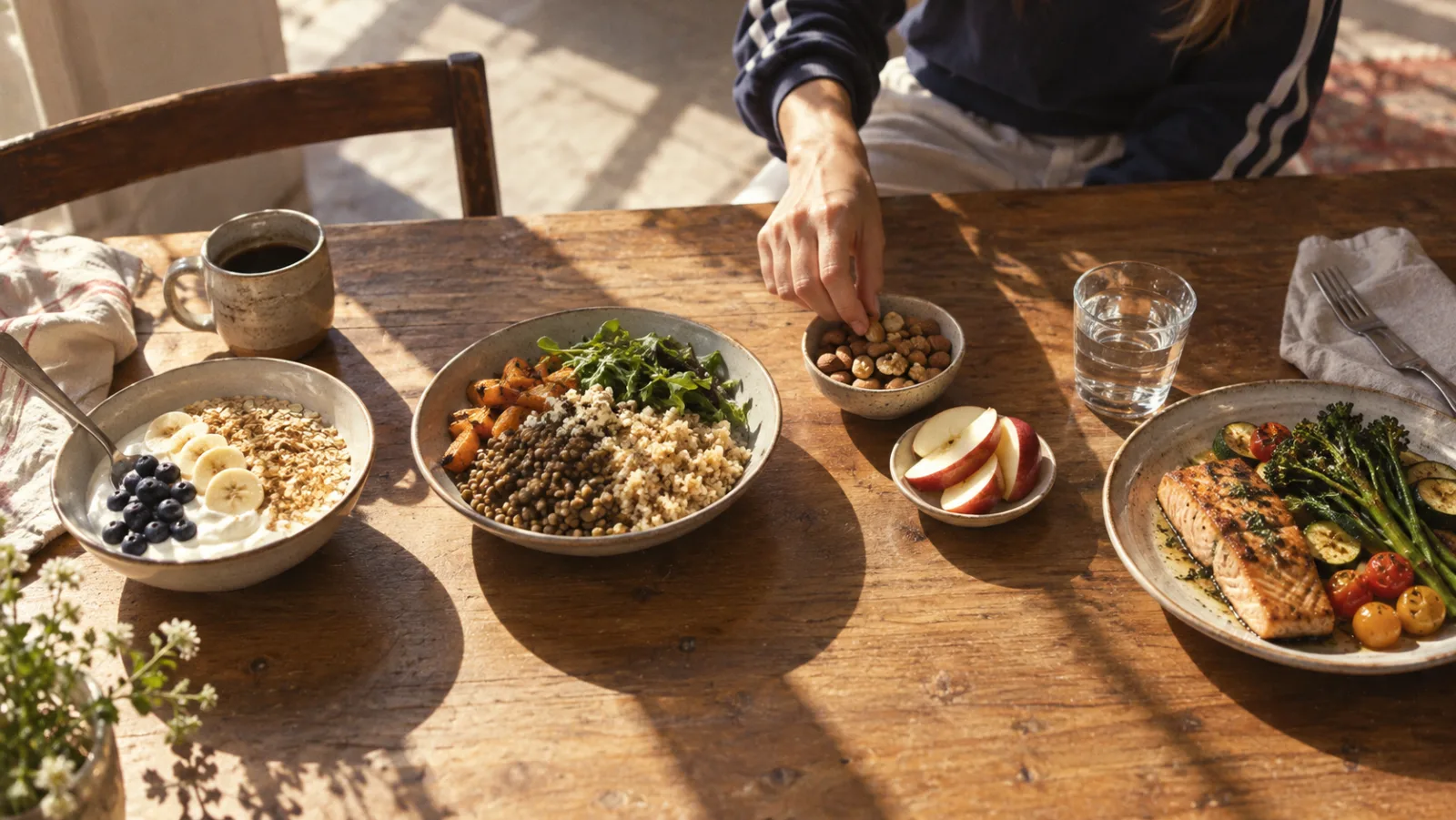
For most exercising adults, the International Society of Sports Nutrition recommends 1.4–2.0 grams of protein per kilogram of body weight daily. A target near 1.6 g/kg sits within that range and has support from reviews of resistance-training research. Count protein from food and supplements together. [1], [2], [3]
For an 80 kg man, 1.6 g/kg works out to about 128 grams a day. That is a practical calculation, not a personalized prescription. It gives you somewhere to start without assuming that everyone needs the highest possible intake. [1], [3]
The familiar 1.6 figure comes partly from a review that estimated a point beyond which additional protein was not associated with further gains in fat-free mass. Its estimate was 1.62 g/kg/day, but the uncertainty was wide. The upper confidence bound of 2.20 g/kg/day does not establish that every lifter needs 2.2 grams. The statistical model also did not establish a definitive breakpoint. [1]
Use the number as a planning aid. The evidence supports an approximate target more strongly than it supports an exact personal ceiling. [1]
Protein supports the work you do in the gym
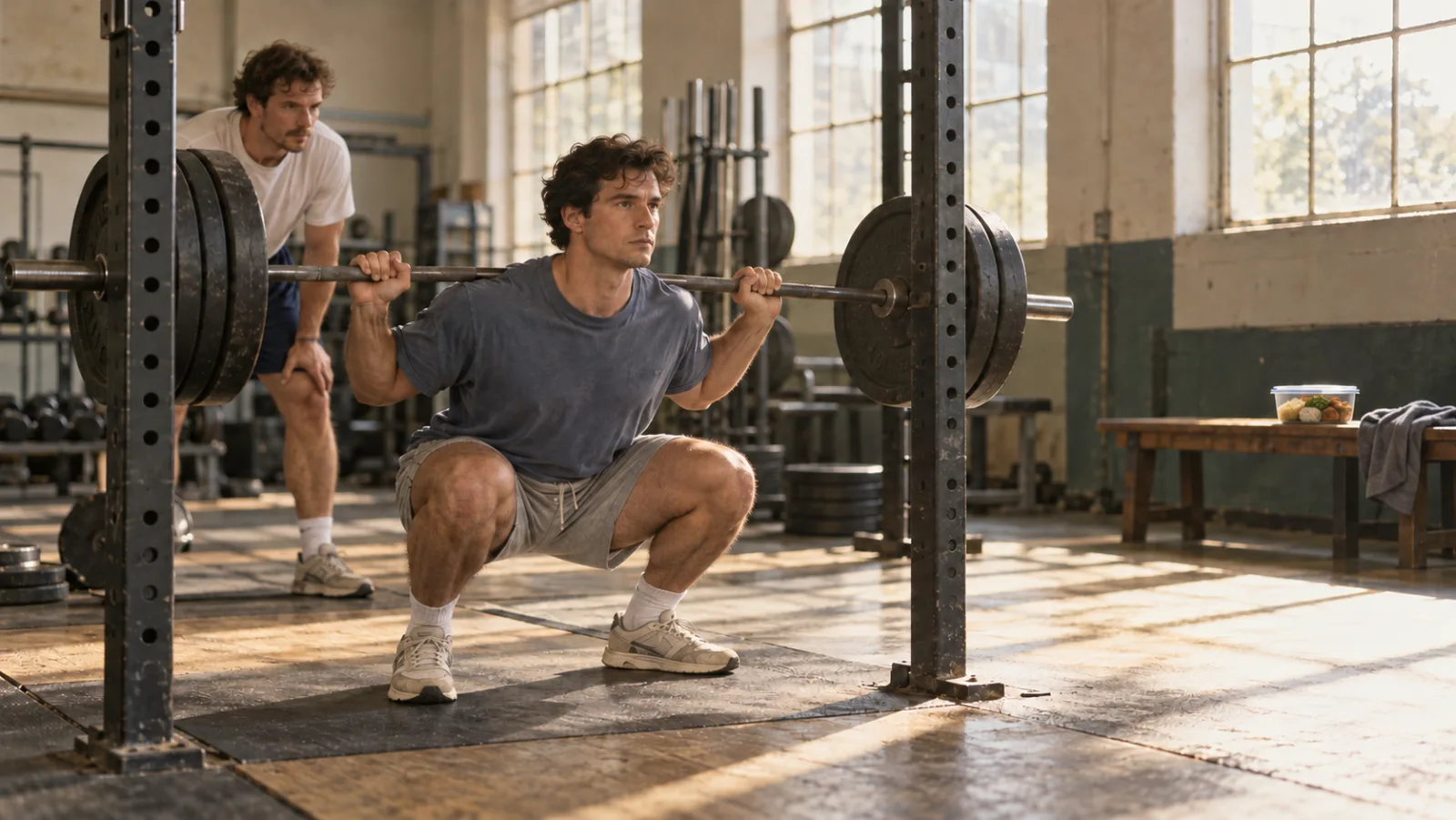
Extra protein can modestly improve the results of resistance training. It does not replace the training stimulus, and a higher intake does not guarantee a larger improvement. That distinction matters when deciding whether another shake is likely to make a meaningful difference. [1], [2]
Across 49 training studies, supplementation added an average of approximately 0.30 kg of fat-free mass and 2.49 kg to pooled one-repetition-maximum strength gains. These are average differences across varied diets, people, and lifts, not a prediction for your next training block. Fat-free mass also includes more than skeletal muscle. [1]
A separate review of 74 trials found small average benefits from additional protein alongside resistance exercise. Most interventions lasted eight to twelve weeks. Together, these findings support getting enough protein while keeping expectations proportionate: protein helps training adaptation, but the extra benefit is usually modest. [2]
Build a food routine before choosing a supplement
Protein powder is a convenient way to meet your daily intake, not a requirement for building muscle. If your meals already provide an adequate amount, a supplement has no guaranteed additional advantage. If you struggle to reach your target, a tolerable protein-rich food or powder can make consistency easier. [3]
Start by accounting for protein across the foods you normally eat. The daily total includes meals, snacks, and shakes; powder does not belong in a separate category of “muscle-building” protein. Choose options that fit your food allergies, digestive tolerance, and overall dietary needs. [1], [3]
Cost can also shape what you can sustain. If that is your main constraint, exploring ways to eat plenty of protein on a budget is a relevant next step.
The practical aim is a workable eating pattern. A supplement earns its place when it helps you meet that aim, rather than simply making your intake higher. [3]
You do not need to chase an immediate post-workout shake
Eating protein before or after a workout can fit a sensible routine. Current direct comparisons do not establish a reliable muscle-growth advantage for one over the other, so convenience is a reasonable consideration for recreational lifters. [3], [4]
A 2025 review combined five studies comparing pre-exercise and post-exercise protein during progressive training. It found no detected difference in lean mass. However, the evidence was rated low to very low certainty. That means a strict timing rule is difficult to justify; it does not prove the two approaches are identical or that long periods without food never matter. [4]
There is also a difference between a short-term response and a lasting result. Researchers can measure how quickly muscle makes new proteins after feeding, a process called muscle protein synthesis. That measurement helps explain physiology, but it does not directly show how much muscle someone will build over months. [3]
Acute findings therefore cannot establish an exact protein limit for every meal. Choose protein-containing meals around a sustainable schedule, without treating a missed immediate shake as a lost workout. For the related timing concern, the anabolic-window question offers a natural topic to explore. [3], [4]
Plant protein can support muscle growth

Animal protein is not mandatory for training adaptation. Plant-based lifters can meet their needs with suitable protein foods, although the strength of the evidence differs between sources. Soy has better support than sweeping claims about all plant proteins would suggest. [5]
A 2025 review found a small overall muscle-mass advantage for animal protein in pooled comparisons. Yet across 17 trials comparing soy with milk, it found no detected difference in muscle-mass outcomes. Overall strength differences between plant and animal protein were not statistically significant. [5]
Other plant proteins did not hold up as well. In five trials, non-soy sources such as rice, chia, oat, and potato protein produced significantly less lean-mass gain than animal protein (SMD −0.58), and fully plant-based diets fell short too (SMD −0.51, seven trials), with larger gaps in people under 60. If you train on plants, lean on soy or mix several protein sources. [5]
For a plant-based trainee, the practical priorities remain adequate total protein and dietary variety. The evidence does not justify inventing a universal extra gram target simply because someone avoids animal foods. [5]
Dieting, age, and body size can change the context
The general target needs qualification when you deliberately restrict calories. A short trial in young, overweight, recreationally active men found better lean-mass outcomes with 2.4 rather than 1.2 g/kg/day during a large calorie deficit and intensive exercise. Performance improved similarly in both groups. [6]
Those men were not regularly resistance training beforehand. The intervention lasted four weeks, used roughly a 40% energy restriction, and involved exercise six days a week. It supports considering higher protein in that demanding setting, but it neither establishes a universal dieting dose nor promises muscle gain during every weight-loss attempt. [6]
If you are cutting calories, maintain resistance exercise and consider protein intake through individualized dietary planning. The broader question of preserving muscle while losing weight is relevant because dieting changes the setting in which protein advice applies. [6]
Age also deserves care. Reviews do not establish an exact optimum for older men, and younger-adult results cannot settle that question. Likewise, evidence from healthy, non-obese adults does not justify treating a body-weight calculation as precise when current weight includes substantial excess fat. [1], [2]
Kidney findings have important limits
Studies in adults without chronic kidney disease are reassuring about the kidney markers measured, but they cannot prove lifelong safety or establish a safe intake for people with kidney disease. A 2026 review found higher estimated filtration without a significant change in serum creatinine, a blood marker used to assess kidney function. [7]
Higher filtration alone proves neither healthier kidneys nor kidney damage. Most studies were relatively short, and their measurements were not long-term clinical outcomes. If you have known kidney disease, seek qualified dietary advice before adopting exercise-oriented high-protein targets. [7]
A useful target, with room for individual needs
For healthy recreational lifters, how much protein men need to build muscle has a practical starting answer: around 1.6 g/kg/day, within a broader 1.4–2.0 range. Meet it through a sustainable mix of foods and optional supplements, and treat timing as flexible. Dieting, older age, substantial excess body fat, and kidney disease require more qualified conclusions than a single number can provide. [1], [2], [3], [4], [6], [7]
Sources
- A systematic review, meta-analysis and meta-regression of the effect of protein supplementation on resistance training-induced gains in muscle mass and strength in healthy adults. British Journal of Sports Medicine, 2018. Direct article. DOI: 10.1136/bjsports-2017-097608.
- Systematic review and meta-analysis of protein intake to support muscle mass and function in healthy adults. Journal of Cachexia, Sarcopenia and Muscle, 2022. Direct article. DOI: 10.1002/jcsm.12922.
- International Society of Sports Nutrition Position Stand: protein and exercise. Journal of the International Society of Sports Nutrition, 2017. Direct article. DOI: 10.1186/s12970-017-0177-8.
- Does Protein Ingestion Timing Affect Exercise-Induced Adaptations? A Systematic Review with Meta-Analysis. Nutrients, 2025. Direct article. DOI: 10.3390/nu17132070.
- Effect of Plant Versus Animal Protein on Muscle Mass, Strength, Physical Performance, and Sarcopenia: A Systematic Review and Meta-analysis of Randomized Controlled Trials. Nutrition Reviews, 2025. Direct article. DOI: 10.1093/nutrit/nuae200.
- Higher compared with lower dietary protein during an energy deficit combined with intense exercise promotes greater lean mass gain and fat mass loss: a randomized trial. The American Journal of Clinical Nutrition, 2016. Direct article. DOI: 10.3945/ajcn.115.119339.
- Effects of High-Protein Diets on Renal Function and Body Composition in Adults Without Chronic Kidney Disease: A Systematic Review and Meta-Analysis of Randomised Trials. Diabetes, Obesity and Metabolism, 2026. Direct article. DOI: 10.1111/dom.70996.