
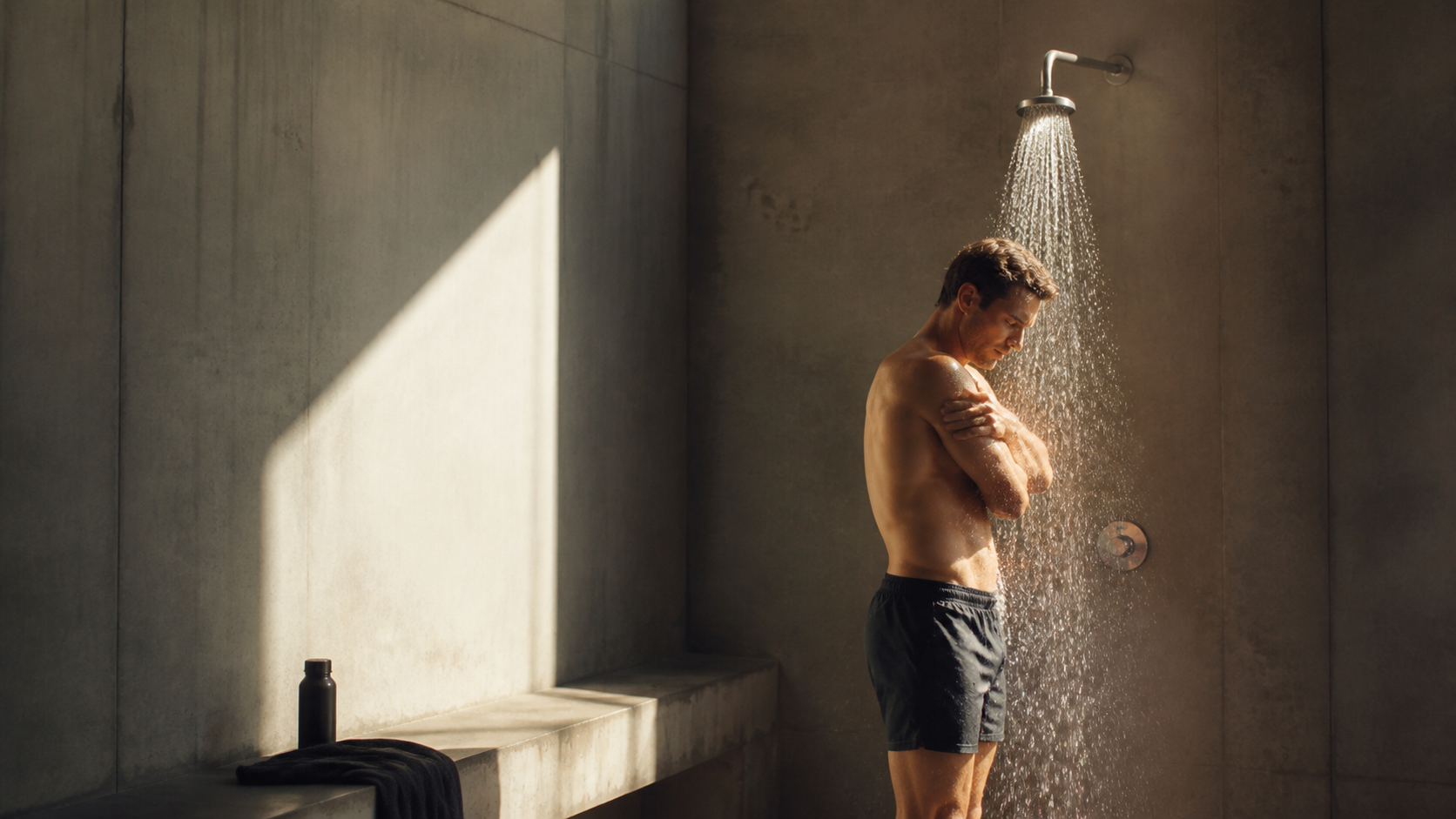
You finish a hard workout, turn the shower handle toward cold, and brace for the shock. The ritual feels decisive: surely something this uncomfortable must speed recovery or strengthen the body. Cold water does create a real physiological response, but the benefits depend heavily on the dose and the goal. The useful question is not whether cold “does something,” but whether a brief shower does enough to improve recovery, performance, health, or long-term training results.
A Cold Shower Is Not a Cold-Water Plunge
Most confident claims about post-workout cold come from cold-water immersion, not showers. In immersion studies, a large part of the body is submerged—often in water at 15°C or colder—for several minutes. The water remains in contact with the skin, removes substantial heat, and adds hydrostatic pressure around the body.
A shower is a smaller and less consistent dose. The spray moves across a limited area, temperature varies, and the exposure commonly lasts only 30 to 90 seconds. Body coverage, duration, and cooling method all shape the response.
Direct shower evidence is sparse. A small study found that repeated cold showers reduced part of the breathing response when participants were later immersed in 10°C water. This shows that showers can produce an acute cold stimulus and some respiratory habituation. It does not show better fitness, faster recovery, or broader health improvements [2].
So when an immersion study reports a benefit, applying it to a quick rinse requires caution. The same logic works in the other direction: evidence that frequent, prolonged immersion may interfere with muscle adaptation does not prove that one brief shower will do the same.
What Cold Can—and Cannot—Do for Recovery
After a single strenuous session, cold-water immersion can help people feel less sore and more recovered. A large synthesis of 52 studies found improvements in soreness and perceived recovery around 24 hours after hard exercise. Muscular power showed small, time-specific improvements, but maximal strength recovery did not improve significantly [3]. Another review also found that immersion reduced soreness, though it could not identify a reliably superior temperature [4].
For a man facing several matches, events, or demanding sessions within a short window, feeling better the next day may be genuinely useful. In that setting, immediate performance matters more than extracting every possible adaptation from one workout. Even then, the expected benefit is modest and depends on the outcome being measured.
Feeling less sore is not the same as having repaired muscle faster. Changes in creatine kinase or inflammatory markers are biological signals, not direct proof that strength and readiness have returned.
If you have a day or two before training the same muscles again, a small change in soreness may not alter the next session. Sleep, food, hydration, sensible progression, and adequate recovery time remain the priorities. These immersion findings do not establish the same effect from a short shower [3], [4].
The Muscle-Growth Trade-Off Applies Mainly to Immersion
Acute recovery and long-term adaptation are different goals. Cooling may make the hours after training feel easier while also reducing some of the signals involved in adapting to resistance work.
Meta-analyses suggest that regularly using cold-water immersion immediately after lifting can slightly reduce strength and muscle gains. A 2024 review favored resistance training alone for hypertrophy, although few studies were available and their quality was generally limited [5]. Two other reviews pointed toward reduced strength adaptation [6], [7].
The clearest controlled example followed young men through 12 weeks of twice-weekly resistance training. Those who completed 10 minutes of 10°C lower-body immersion after training gained less muscle and strength than those using active recovery. Acute muscle samples also showed reduced anabolic signaling and satellite-cell activity [8]. In plain language, substantial cooling appeared to dampen parts of the rebuilding response, and the long-term results moved in the same direction.
This does not mean cold destroys gains. The evidence largely involves young men, small samples, varied protocols, and repeated high-dose immersion. It supports avoiding prolonged, large-body cooling immediately after most hypertrophy-focused sessions. It does not show that a 30-second rinse erases a workout, and research has not identified a proven delay after which cooling becomes harmless.
Immunity, Mood, Sleep, and the Appeal of Feeling Alert
The strongest shower-specific health trial included 3,018 employed adults. For 30 days, participants ended a normal shower with 30, 60, or 90 seconds of the coldest available water. The cold-shower groups reported 29% less sickness absence from work, but they did not report fewer days of illness. Longer cold phases were no better than 30 seconds [1].
That result does not prove stronger immunity. Participants knew their treatment, adherence and outcomes were self-reported, water temperature varied, and illness did not last fewer days. Cold showering may have changed the decision to attend work without changing illness itself.
A 2025 review of 11 randomized cold-water trials found time-dependent changes in stress, sleep quality, quality of life, inflammation, and immune measures. The studies used different cold interventions, measurement times, and outcomes; most examined immersion rather than ordinary showers, and many results were biomarkers or self-reports [9]. The evidence therefore does not support broad promises about immunity, mood, sleep, or long-term cardiovascular health.
An immediate sense of alertness is plausible. Sudden cooling triggers gasping, faster breathing, vasoconstriction, and temporary increases in heart rate and blood pressure [10]. That jolt can feel energizing, but a noticeable sensation is not automatically a durable health benefit.
Cold Showers Are Not a Fat-Loss or Endurance Strategy
Regular cold-water immersion has not produced meaningful improvements in time-trial performance or maximal aerobic performance during endurance training [6]. Cooling before prolonged exercise in hot conditions is a separate heat-management tactic; it does not show that a daily cold shower builds endurance.
Cold can also increase thermoregulatory activity, particularly when shivering occurs. But short-term changes in energy expenditure, stress hormones, or brown-fat activity do not demonstrate meaningful fat loss [10]. For aerobic fitness and body-fat reduction, a cold shower is not a substitute for progressive training and an appropriate nutrition plan.
A Practical Way to Use Cold
Healthy recreationally active men can treat a cold finish as optional. The shower trial found no advantage to extending the cold phase from 30 seconds to 60 or 90 seconds, so there is no evidence-based reason to chase discomfort [1].
Match the method to the goal:
- For ordinary recovery, do not expect a cold shower to restore strength or reliably improve the next workout.
- For tournaments or unusually congested schedules, immersion may modestly reduce soreness and improve perceived recovery, though objective performance effects are inconsistent [3], [4].
- For muscle and strength goals, avoid making prolonged immediate immersion a routine after every lifting session [5]–[8].
- For endurance or fat loss, keep the focus on training and nutrition rather than cold exposure [6], [10].
Cold also deserves basic respect. The initial shock can cause gasping, rapid breathing, dizziness, panic, palpitations, or a temporary blood-pressure surge. Immersion carries greater cold-shock and drowning risk, but showers are not risk-free. Stop if you develop chest discomfort, marked breathlessness, palpitations, numbness, prolonged uncontrollable shivering, or dizziness.
Men with cardiovascular disease, uncontrolled hypertension, arrhythmias, significant lung disease, Raynaud’s phenomenon, cold urticaria, impaired sensation, or a history of fainting should seek clinical guidance before deliberate intense cold exposure [1], [10]. Habituation may reduce part of the respiratory response, but it does not eliminate cardiovascular risk [2].
Conclusion
Cold showers are a real stimulus, but the evidence does not support treating them as a required recovery, muscle-building, fat-loss, or health tool. Immersion can modestly reduce soreness after hard exercise, while frequent immediate immersion may slightly blunt resistance-training adaptation; neither finding transfers neatly to a brief shower. If you enjoy a cold finish and tolerate it well, use it as a personal ritual—not as proof that more pain produces more benefit.
Sources
- The Effect of Cold Showering on Health and Work: A Randomized Controlled Trial. PLOS ONE. 2016. Direct article. DOI: 10.1371/journal.pone.0161749. PMID: 27631616.
- Repeated Cold Showers as a Method of Habituating Humans to the Initial Responses to Cold Water Immersion. European Journal of Applied Physiology. 2005. PubMed record. DOI: 10.1007/s00421-004-1239-6. PMID: 15778892.
- Impact of Cold-Water Immersion Compared with Passive Recovery Following a Single Bout of Strenuous Exercise on Athletic Performance in Physically Active Participants: A Systematic Review with Meta-analysis and Meta-regression. Sports Medicine. 2022. Full text. DOI: 10.1007/s40279-022-01644-9. PMID: 35157264.
- What Parameters Influence the Effect of Cold-Water Immersion on Muscle Soreness? An Updated Systematic Review and Meta-Analysis. Clinical Journal of Sport Medicine. 2023. PubMed record. DOI: 10.1097/JSM.0000000000001081. PMID: 36399666.
- Throwing Cold Water on Muscle Growth: A Systematic Review with Meta-analysis of the Effects of Postexercise Cold Water Immersion on Resistance Training-Induced Hypertrophy. European Journal of Sport Science. 2024. Full text. DOI: 10.1002/ejsc.12074. PMID: 38775443.
- The Effects of Regular Cold-Water Immersion Use on Training-Induced Changes in Strength and Endurance Performance: A Systematic Review with Meta-Analysis. Sports Medicine. 2021. PubMed record. DOI: 10.1007/s40279-020-01362-0. PMID: 33146851.
- Effects of Post-Exercise Cold-Water Immersion on Resistance Training-Induced Gains in Muscular Strength: A Meta-analysis. European Journal of Sport Science. 2023. PubMed record. DOI: 10.1080/17461391.2022.2033851. PMID: 35068365.
- Post-Exercise Cold Water Immersion Attenuates Acute Anabolic Signalling and Long-Term Adaptations in Muscle to Strength Training. The Journal of Physiology. 2015. Full text. DOI: 10.1113/JP270570. PMID: 26174323.
- Effects of Cold-Water Immersion on Health and Wellbeing: A Systematic Review and Meta-Analysis. PLOS ONE. 2025. Direct article. DOI: 10.1371/journal.pone.0317615. PMID: 39879231.
- Cold Water Immersion: Kill or Cure? Experimental Physiology. 2017. PubMed record. DOI: 10.1113/EP086283. PMID: 28833689.