
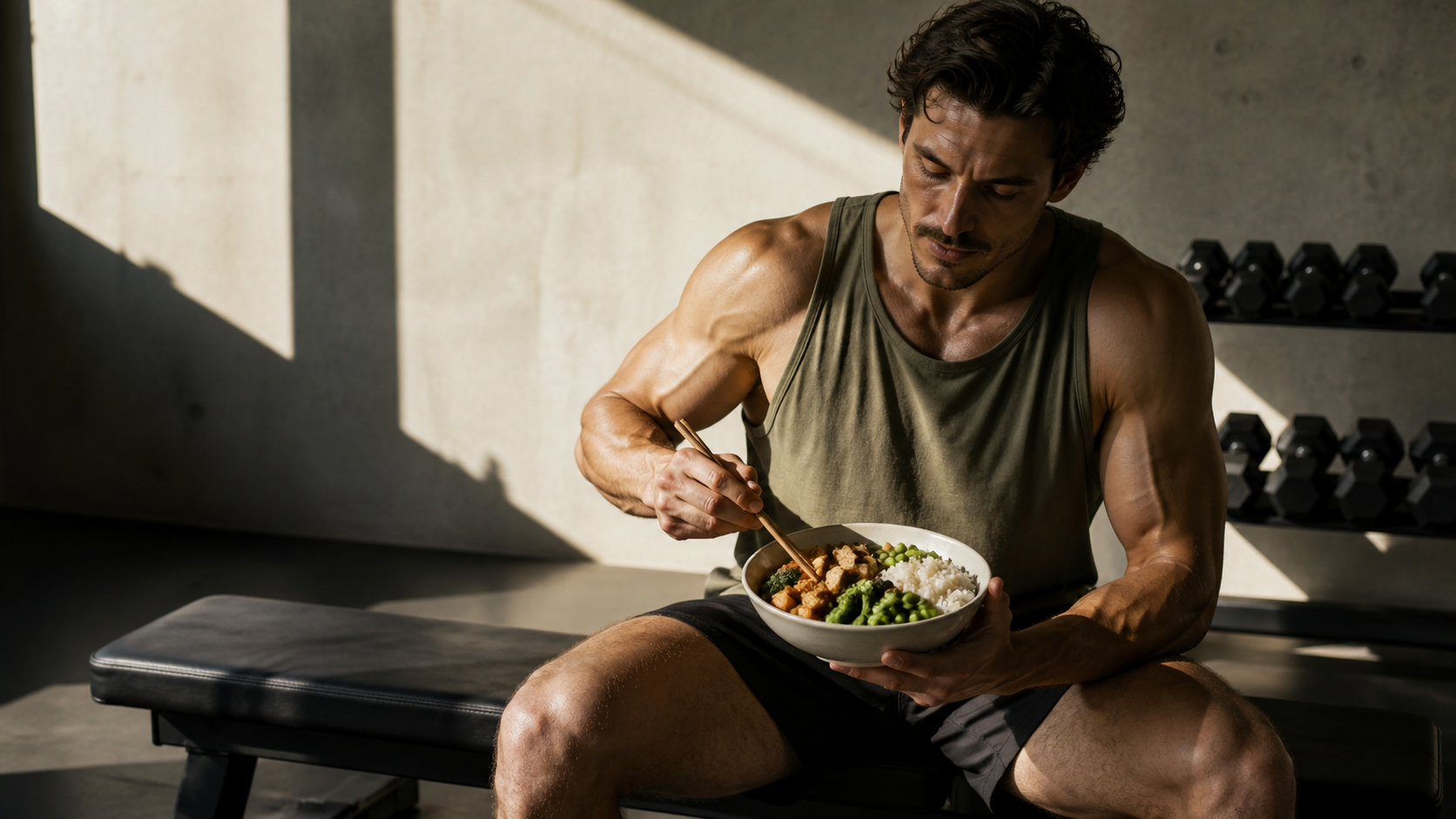
Soy can look like a protein choice until warnings about testosterone turn lunch into a biology debate. The useful question is not whether soy changes an abstract idea of masculinity. It is whether normal amounts affect hormones, fertility, muscle growth, or performance. Human research gives clear answers in some areas—and sensible limits in others.
What the Hormone Evidence Actually Shows
Soy contains isoflavones, plant compounds that can interact with estrogen receptors. That mechanism sounds alarming when it is stripped of dose and context, but a possible interaction in the body is not the same as a harmful hormonal outcome.
The strongest human evidence is an updated meta-analysis of 41 clinical studies involving men aged 18 to 81. Across the studies, soy foods, soy protein, and soy isoflavones did not significantly change total testosterone, free testosterone, estradiol, estrone, or sex hormone-binding globulin. The result remained null when researchers separated studies by duration and by isoflavone intake below or above 75 mg per day [1].
That does not prove that every imaginable dose is harmless, and blood tests cannot capture every biological effect. The studies also differed in design, population, soy product, and duration. Still, this evidence is much more relevant to ordinary eating than animal experiments or isolated stories. At the intakes studied, a clinically meaningful feminizing hormone effect is unlikely.
One small trial can sound like an exception. Ten resistance-trained men took soy, whey, or carbohydrate for 14 days before a squat workout. Soy partly blunted the post-exercise testosterone response, while estradiol did not differ [8]. But this was a brief fluctuation, not a sustained fall in resting testosterone. The study did not measure muscle or strength gains, and acute hormone changes are not established stand-ins for long-term hypertrophy.

Soy Protein and Building Muscle
The practical test of a protein is what happens after weeks of training. A meta-analysis of nine resistance-training studies involving 266 participants found no significant difference between soy and animal proteins for gains in lean body mass, bench-press strength, or squat and leg-press strength [2]. The evidence mixed ages, sexes, and training backgrounds, so it cannot rule out small differences in every group. One author also disclosed an industry relationship.
A 12-week study offers a useful real-world comparison. Nineteen habitual vegans and 19 omnivorous, untrained young men completed supervised resistance training twice a week. Both groups ate about 1.6 grams of protein per kilogram of body weight per day, using soy isolate for the vegan group and whey for the omnivorous group. Both improved leg lean mass, muscle size, muscle-fiber area, and leg-press strength, with no significant difference between groups [6].
This does not mean every scoop of soy is nutritionally identical to every scoop of whey. In an acute tracer study, whey produced a 31% higher post-exercise mixed-muscle protein-synthesis response than soy when servings supplied the same amount of essential amino acids. Soy still stimulated muscle protein synthesis and outperformed casein in that experiment [5]. The study followed only 18 young men—six per group—for hours after one workout. It measured an immediate laboratory response, not new muscle built over months.
Protein quality matters, but it sits inside a larger system. Daily protein, serving size, diet quality, progressive overload, energy intake, and consistency all shape adaptation. For most exercising adults, the International Society of Sports Nutrition gives a general daily range of 1.4–2.0 grams per kilogram and a per-meal framework of 20–40 grams, or about 0.25 grams per kilogram, of high-quality protein [4]. These are general ranges, not mandatory targets or a soy-specific formula.
Men who rely heavily on plant protein can use substantial servings of soy across the day rather than assuming every gram from every source produces the same acute response. Evidence does not establish an exact soy-to-whey conversion, particularly for older men or trained lifters. It does show that adequate soy protein can support meaningful strength and muscle gains.
Fertility and Sexual Function: Reassuring but Limited
Fertility claims require more caution because the direct evidence is smaller. In a randomized crossover trial, healthy young men consumed milk protein, low-isoflavone soy isolate, and high-isoflavone soy isolate for 57 days each, with washout periods between them. The high-isoflavone condition supplied about 61.7 mg per day. Soy did not adversely affect semen volume, sperm concentration, total count, motility, total motile count, or morphology [7].
That is reassuring, but semen measurements are not the same as conception, pregnancy, or live birth. The small trial cannot exclude uncommon effects or address men receiving infertility care. Observational fertility-clinic research may find associations, but confounding and selection bias prevent them from proving that soy caused a change.
Two case reports have linked exceptionally high soy exposure with reversible gynecomastia or hypogonadal symptoms. In one, a 60-year-old man drank three quarts of soy milk daily and developed breast enlargement, altered estrogen levels, and sexual symptoms that improved after he stopped. The estimated exposure in the reported cases was around 360 mg of isoflavones per day [1], [9]. These reports cannot establish how often this happens or define a harmful threshold. They do show why an extreme, monotonous intake should not be treated as equivalent to tofu at dinner or a soy shake after training.
New breast tissue, nipple tenderness, persistent loss of libido, or erectile dysfunction deserves clinical evaluation. Soy should not automatically be blamed, because medications, changes in body fat, liver disease, hypogonadism, and other factors may be involved.
Performance and Recovery Beyond the Gym
Soy supplies protein that can contribute to repair, but it is not a proven endurance enhancer. A 2023 systematic review covered 19 randomized trials in athletes or physically active people. Only six assessed performance, and their sports, comparators, doses, and outcomes varied widely. Some reported improvements in time to fatigue, running velocity, lactate, or cycling measures, while findings for maximal oxygen uptake conflicted. The review did not produce a pooled performance effect [3].
Changes in antioxidant or muscle-damage markers do not automatically mean faster recovery. Runners and cyclists can use soy to meet protein needs, but carbohydrate, sufficient energy, hydration, sleep, and training-load management remain more direct priorities. Extra protein at the expense of needed carbohydrate may be counterproductive during high-volume endurance work [3], [4].

Practical Takeaways
For healthy adult men who exercise, soy foods and protein can fit into a varied diet. The realistic benefit is useful protein and essential amino acids—not a special testosterone or recovery effect.
- Build the diet around sufficient total protein and energy, then choose sources that suit your preferences, budget, and digestion.
- Pair protein intake with progressive resistance training if muscle and strength are the goals. Soy is unlikely to impair gains when overall protein intake is adequate.
- Use a meaningful serving and distribute protein-containing meals through the day, especially if most of your protein is plant-based.
- Keep endurance fueling in balance. Protein supports repair, but it should not crowd out carbohydrate needed for demanding training.
- Avoid making very large quantities of one soy product or concentrated isoflavone supplements the center of the diet. There is no demonstrated performance reason to approach the extreme exposures described in case reports.
These conclusions apply most directly to healthy adults consuming studied amounts. Men with a soy allergy should avoid soy. Anyone who requires individualized protein management should follow clinician-guided targets.
Conclusion
Soy does not make men “less masculine” in any scientifically useful sense. The best clinical evidence finds no meaningful effect on male reproductive hormones, and resistance-training research shows that soy can support muscle and strength when protein intake and training are adequate. Fertility and endurance evidence is less complete, so confidence should stop short of claiming unlimited safety or special performance benefits. For most men, soy is best treated as what it is: one practical protein option within a varied diet.
Sources
- Neither soy nor isoflavone intake affects male reproductive hormones: An expanded and updated meta-analysis of clinical studies. Reproductive Toxicology, 2021. Direct article. DOI: 10.1016/j.reprotox.2020.12.019. PMID: 33383165.
- No Difference Between the Effects of Supplementing With Soy Protein Versus Animal Protein on Gains in Muscle Mass and Strength in Response to Resistance Exercise. International Journal of Sport Nutrition and Exercise Metabolism, 2018. Direct article. DOI: 10.1123/ijsnem.2018-0071. PMID: 29722584.
- Effect of Soy Protein Supplementation on Muscle Adaptations, Metabolic and Antioxidant Status, Hormonal Response, and Exercise Performance of Active Individuals and Athletes: A Systematic Review of Randomised Controlled Trials. Sports Medicine, 2023. Direct article. DOI: 10.1007/s40279-023-01899-w. PMID: 37603200.
- International Society of Sports Nutrition Position Stand: protein and exercise. Journal of the International Society of Sports Nutrition / International Society of Sports Nutrition, 2017. Direct article. DOI: 10.1186/s12970-017-0177-8. PMID: 28642676.
- Ingestion of whey hydrolysate, casein, or soy protein isolate: effects on mixed muscle protein synthesis at rest and following resistance exercise in young men. Journal of Applied Physiology, 2009. Direct article record. DOI: 10.1152/japplphysiol.00076.2009. PMID: 19589961.
- High-Protein Plant-Based Diet Versus a Protein-Matched Omnivorous Diet to Support Resistance Training Adaptations: A Comparison Between Habitual Vegans and Omnivores. Sports Medicine, 2021. Direct article. DOI: 10.1007/s40279-021-01434-9. PMID: 33599941.
- Soy protein isolates of varying isoflavone content do not adversely affect semen quality in healthy young men. Fertility and Sterility, 2010. Direct article record. DOI: 10.1016/j.fertnstert.2009.08.055. PMID: 19819436.
- The effects of soy and whey protein supplementation on acute hormonal responses to resistance exercise in men. Journal of the American College of Nutrition, 2013. Direct article record. DOI: 10.1080/07315724.2013.770648. PMID: 24015701.
- An unusual case of gynecomastia associated with soy product consumption. Endocrine Practice, 2008. Direct article record. DOI: 10.4158/EP.14.4.415. PMID: 18558591.