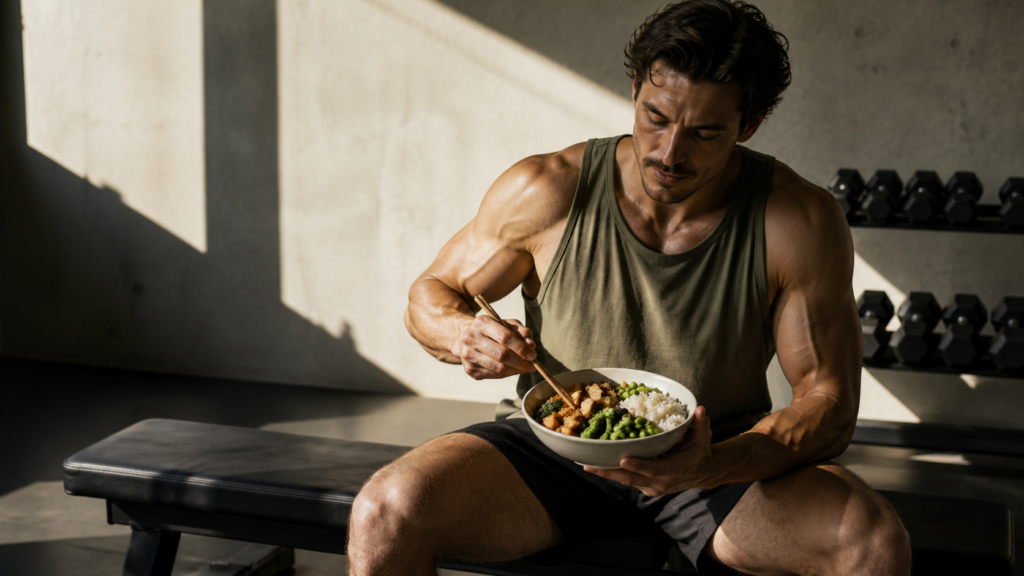

You start lifting, tighten up your diet, and a few months later your waist is smaller while your shoulders look broader. It is tempting to say that the fat has turned into muscle. The visible result can look that way, but the biology is different—and understanding that difference makes it easier to train, eat, and measure progress sensibly. The useful goal is not transformation of one tissue into another, but body recomposition: losing fat while building or preserving muscle.
Two Tissues, Two Separate Jobs
Body fat and skeletal muscle are distinct tissues made from different kinds of cells. Fat tissue stores energy, largely as triglycerides; when your body needs that energy, it mobilizes and oxidizes stored fat. Muscle growth follows another route: repeated training supports a net accumulation of muscle protein, allowing fibers to become larger.
Fat cells therefore do not become muscle fibers. During recomposition, fat mass falls while muscle or fat-free mass rises over the same period. The changes happen side by side [8][9]. Fat loss requires an energy balance that allows stored energy to be used, while muscle gain or retention requires challenging training, enough protein, and adequate recovery. Push the diet too hard and it may accelerate weight loss while making muscle gain less likely.
Why the Scale Can Tell an Incomplete Story
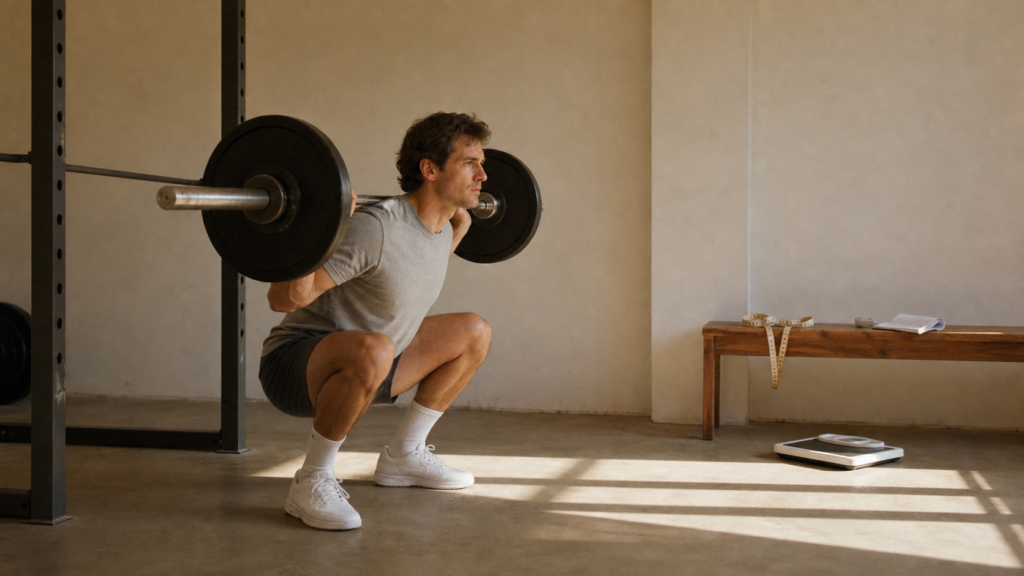
If you lose fat and gain lean tissue together, body weight may change slowly or stay stable. Body-composition measurements are not perfect substitutes: “fat-free mass” includes water, glycogen, organs, and other non-fat tissue as well as muscle. Hydration, meals, carbohydrate intake, and test timing can also shift short-term readings [2][8][9].
Use several trends together:
- body weight measured consistently and considered as a trend;
- waist circumference taken in the same way each time;
- performance in repeatable lifts;
- standardized body-composition testing, if available.
No single marker proves that muscle was gained. A shrinking waist alongside stable or improving performance is more informative than one weigh-in or body-fat reading.
Resistance Training Is the Central Signal
Dieting can reduce body mass, but resistance training supplies the signal to retain or build muscle. It can also contribute modestly to fat loss without a prescribed diet.
Across 54 randomized comparisons in healthy adults, resistance training reduced body-fat percentage by an average of 1.46 percentage points and fat mass by 0.55 kg compared with no exercise [1]. Those effects are modest; lifting is not usually a rapid fat-loss method by itself.
Its value becomes especially clear during a diet. In 25 randomized trials involving adults with overweight or obesity, adding resistance exercise did not materially increase total scale-weight loss. It preserved more fat-free mass, increased fat-mass loss, and improved strength compared with dieting alone [2]. Two people can therefore lose similar weight but finish with different amounts of fat and lean tissue.
No single recomposition routine is uniquely effective. Train the major muscle groups and progress through load, repetitions, range of motion, or manageable volume. During fat loss, preserve the quality of key lifts instead of replacing most lifting with extra calorie-burning exercise.
The Energy-Deficit Trade-Off
A calorie deficit supports fat loss, but a larger or longer deficit makes muscle growth harder. A meta-analysis found that energy deficiency impaired lean-mass gains, although strength gains were not significantly different. Technique and nervous-system adaptations can increase strength even when muscle growth is limited [3].
The same analysis estimated that a deficit of about 500 kcal per day prevented lean-mass gain on average. This study-level estimate is not a personal cutoff; energy needs, reported intake, and body-composition measures all contain error [3].
Use the smallest restriction that produces the desired fat-loss trend while allowing productive training and recovery. Persistent declines in performance, mood, or recovery are reasons to reassess food intake and workload. Leaner, experienced lifters have less room for error.
Protein Helps, but It Cannot Rescue the Whole Plan
Protein supplies the building blocks for muscle. Across 49 trials and 1,863 participants, supplementation added about 0.30 kg of fat-free mass and 2.49 kg of one-repetition-maximum strength on average. In energy-balanced conditions, no further average fat-free-mass benefit appeared beyond roughly 1.62 g/kg per day [4].
For most exercising adults, about 1.4–2.0 g/kg per day is a practical range. During a substantial deficit, higher intake may provide extra protection, but evidence for exact high-dose targets comes from small, short trials in young men [6].
In one four-week trial, 40 young men trained six days per week under a roughly 40% energy deficit. The higher-protein group gained 1.2 kg of lean body mass while losing 4.8 kg of fat [6]. This proves possibility under supervised, unusually intensive conditions—not a typical outcome.
More protein is also not a substitute for progressive training, sufficient recovery, or a sustainable deficit. Men with known kidney disease or medically prescribed dietary restrictions should get individualized clinical guidance before making major changes to protein intake.
Cardio Can Fit Without Cancelling Muscle Growth
Cardio is useful for endurance, health, and energy expenditure. It does not usually prevent muscle or maximal-strength gains when combined with lifting in a recoverable program. An updated analysis of supervised concurrent training found no meaningful disadvantage for whole-muscle hypertrophy or maximal strength compared with strength training alone [5].
Explosive strength was more likely to be reduced when aerobic and strength work occurred in the same session [5]. A demanding endurance session can also lower the quality of the lifting that follows, especially when food and recovery are restricted.
When strength, muscle growth, or power is the priority, avoid repeatedly exhausting yourself immediately before key lifting sessions. Separating demanding cardio and lifting when practical, increasing volume gradually, and using lower-impact modes when joints or tendons are irritated can make the combined workload easier to recover from.

Who Is Most Likely to Recompose?
Recomposition has been documented in untrained and overweight people and in some trained lifters [6][9]. It is more achievable for beginners, returners, men with more fat to lose, or anyone receiving a genuinely new training stimulus. Fat loss alongside some muscle gain is possible, not guaranteed.
It becomes less predictable as a trainee gets leaner and more advanced. Separate phases emphasizing fat loss or muscle gain may then be easier to manage and measure.
Research provides no dependable body-fat cutoff, ideal calorie target, or guaranteed rate [9]. Short studies, mixed populations, indirect muscle measures, and fluid shifts limit forecasts. Judge the direction of change over months, not days.
Practical Takeaways
For recreationally active men, the practical approach is straightforward:
- Keep progressive resistance training at the center of the plan.
- Use a moderate, adjustable energy deficit when fat loss is a priority.
- Eat enough protein, while remembering that it supports rather than replaces training.
- Add cardio at a dose that does not repeatedly compromise important lifting sessions.
- Track waist, weight trends, and performance under consistent conditions.
Beginners, returners, and men with more stored fat can pursue both goals together. Lean, advanced trainees should expect smaller, slower changes. Sharp or worsening pain should prompt exercise modification. Persistent fatigue, recurrent injury, markedly reduced libido, or other signs of low energy availability warrant reducing the deficit and seeking qualified assessment.
Conclusion
Fat cannot turn into muscle, but your body can lose one tissue while gaining or preserving the other. Resistance training provides the muscle signal; energy intake influences fat loss and the room available for growth; protein and recovery help the process along. Recomposition is realistic under favorable conditions, but its pace varies, and careful trend tracking is more useful than dramatic promises or a single body-composition reading.
Sources
- The Effect of Resistance Training in Healthy Adults on Body Fat Percentage, Fat Mass and Visceral Fat: A Systematic Review and Meta-Analysis. Sports Medicine. 2022. Direct link. DOI: 10.1007/s40279-021-01562-2. PMID: 34536199.
- Effect of Resistance Exercise on Body Composition, Muscle Strength and Cardiometabolic Health During Dietary Weight Loss in People Living With Overweight or Obesity: A Systematic Review and Meta-Analysis. BMJ Open Sport & Exercise Medicine. 2025. Direct link. DOI: 10.1136/bmjsem-2024-002363. PMID: 40909191.
- Energy Deficiency Impairs Resistance Training Gains in Lean Mass but Not Strength: A Meta-Analysis and Meta-Regression. Scandinavian Journal of Medicine & Science in Sports. 2022. Direct link. DOI: 10.1111/sms.14075. PMID: 34623696.
- A Systematic Review, Meta-Analysis and Meta-Regression of the Effect of Protein Supplementation on Resistance Training-Induced Gains in Muscle Mass and Strength in Healthy Adults. British Journal of Sports Medicine. 2018. Direct link. DOI: 10.1136/bjsports-2017-097608. PMID: 28698222.
- Compatibility of Concurrent Aerobic and Strength Training for Skeletal Muscle Size and Function: An Updated Systematic Review and Meta-Analysis. Sports Medicine. 2022. Direct link. DOI: 10.1007/s40279-021-01587-7. PMID: 34757594.
- Higher Compared With Lower Dietary Protein During an Energy Deficit Combined With Intense Exercise Promotes Greater Lean Mass Gain and Fat Mass Loss: A Randomized Trial. The American Journal of Clinical Nutrition. 2016. Direct link. DOI: 10.3945/ajcn.115.119339. PMID: 26817506.
- International Society of Sports Nutrition Position Stand: Diets and Body Composition. Journal of the International Society of Sports Nutrition. 2017. Direct link. DOI: 10.1186/s12970-017-0174-y. PMID: 28630601.
- Body Recomposition: Can Trained Individuals Build Muscle and Lose Fat at the Same Time? Strength and Conditioning Journal. 2020. Direct link. DOI: 10.1519/SSC.0000000000000584.