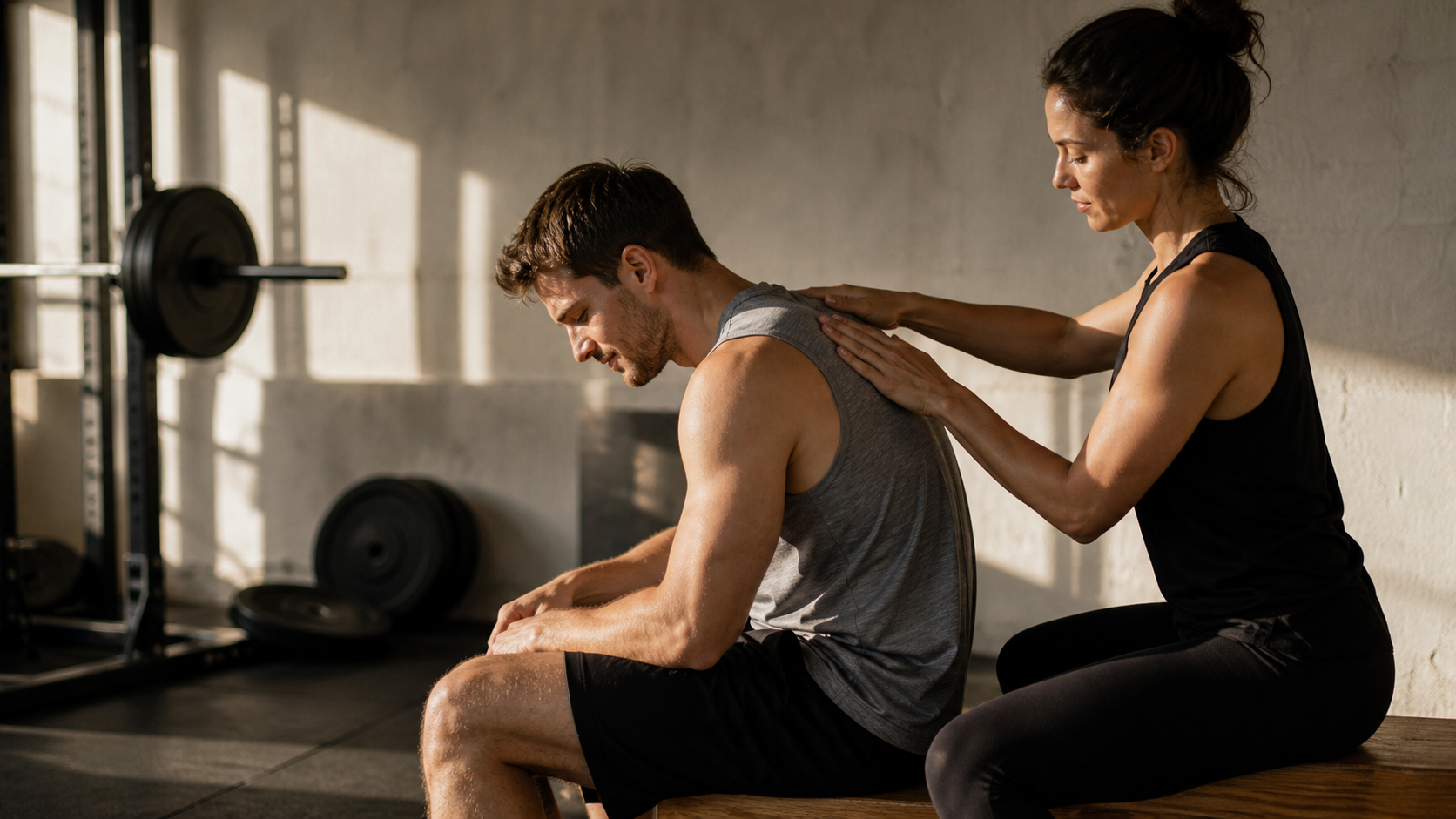
After a hard lifting session, massage can make sore muscles feel looser. That change may seem like part of the muscle-building process. But can massage help build muscle like progressive strength training does? The evidence separates post-workout comfort from the long-term stimulus that makes muscle fibers grow.
The short answer: massage can reduce soreness for some people, but there is no convincing human evidence that it directly increases muscle size. It may be a useful recovery and comfort tool. A reduction in discomfort can still be practically useful, especially after unfamiliar training, but it is symptom relief rather than evidence of faster adaptation [3]. It should not be treated as a substitute for resistance training, adequate nutrition, or enough time to recover.
Can Massage Help Build Muscle Directly?
Massage applies mechanical pressure, but not every form of stress produces the same adaptation. Resistance training makes muscle fibers generate force against a progressively challenging load, reliably increasing muscle size over time in healthy adults [1]. Massage is passive: the muscle does not perform comparable work.
The most direct human evidence tested repeated percussive massage as an isolated stimulus. Participants received 30-minute sessions three times per week for six weeks. Researchers found no increase in type I, type II, or total muscle-fiber cross-sectional area. They also found no increase in satellite-cell abundance or capillary density [2]. In other words, repeated pressure did not reproduce the structural adaptation expected from progressive resistance training.
The trial tested percussive massage, not every manual technique, and did not compare lifting alone with lifting plus massage. A small additive effect has therefore not been definitively excluded. Still, no longitudinal human evidence shows that massage increases hypertrophy. The established growth stimulus remains progressive resistance training [1], [2]. If your loads or repetitions have stalled, examining why lifting numbers stop increasing is more relevant than seeking a passive replacement.
Why Feeling Different Does Not Mean New Muscle
Warmth, temporary fullness, relaxation, or less discomfort are real sensations, but they do not measure new contractile tissue. Muscle growth is a chronic adaptation assessed over time through fiber size, body composition, or sustained performance changes.
An often-cited laboratory study helps explain why the distinction matters. Eleven young men completed exhaustive cycling, then received a 10-minute massage on one quadriceps while the other leg served as a comparison. Muscle biopsies showed short-term changes in inflammatory and mechanical-signaling pathways during the next 2.5 hours. Signaling related to mitochondrial biogenesis also increased, while muscle lactate and glycogen did not change [6].
This shows that muscle senses massage, not that massage increases muscle protein synthesis, fiber size, or strength. An acute molecular signal is not proof of meaningful long-term adaptation. The six-week trial directly measured fiber size and found no hypertrophy [2].
Massage, Soreness, and Recovery
Massage has a stronger case as a way to manage delayed-onset muscle soreness, or DOMS. A 2020 systematic review and meta-analysis included 29 randomized studies with 1,012 participants. It found a small reduction in soreness—about 13% across the included studies—but no overall improvement in strength, jumping, sprinting, endurance, or fatigue [3].
Other reviews reported larger soreness reductions and, sometimes, better recovery of maximal isometric force or peak torque [4], [5]. Results remain mixed because techniques, session lengths, exercise protocols, and controls varied. Many trials were small, soreness is subjective, and participants cannot realistically be blinded to massage.
Massage may make you feel less sore, but this does not prove that force production or tissue has recovered. Readiness also depends on current performance, range of motion, fatigue, and the previous workout. The comparison between sleep and training-program design is useful because massage is optional, not a recovery foundation.
Feeling better could plausibly help a healthy lifter train more consistently, but this behavioral benefit is unproven. Studies have not shown that massage produces more weekly volume, fewer missed sessions, or greater long-term muscle gain [3], [4], [5].
Does Massage Improve Strength or the Next Workout?
Massage should not be expected to increase strength or power directly. In the 2020 meta-analysis, the pooled strength analysis covered 12 studies and 346 participants and found no overall benefit. There was also no pooled improvement in sprint, jump, or endurance performance [3]. Individual studies sometimes produce different results, but isolated findings are less reliable than the combined evidence.
Using massage immediately before a demanding workout is particularly hard to justify as a performance strategy. A systematic review of nine randomized crossover trials found no evidence that pre-performance massage or self-massage improved maximal strength, sprinting, or jumping in young healthy participants. Sessions longer than nine minutes tended to be associated with worse lower-body performance [7]. Because six of the nine trials were low quality, nine minutes should not be treated as a precise universal cutoff. The broader lesson is simply that prolonged passive massage should not replace an active warm-up.
Massage also cannot compensate for weak muscle-building fundamentals. Questions about meal timing, for example, are better considered within the evidence on the so-called anabolic window than attached to the temporary sensations created by massage. A treatment may feel productive without addressing the training and nutrition inputs that drive adaptation.
Where Massage Can Fit in a Muscle-Building Routine
For a healthy recreational trainee, massage is optional supportive care. A tolerable post-exercise session may reduce soreness or perceived fatigue, and the comfort may be worthwhile even without measurable hypertrophy.
There is no evidence-based massage prescription for muscle growth. Recovery studies have used protocols ranging from several minutes to roughly 30 minutes, with different pressures, techniques, and timing [3], [4], [5]. That variation does not justify inventing an “optimal” dose. More time, pressure, or discomfort should not be assumed to create a greater benefit.
Judge massage by its purpose. For comfort, ask whether you feel better without unwanted pain or bruising. For growth, track consistent training, performance, and repeated measures of muscle size or body composition. Reduced soreness, warmth, or a pump-like feeling does not demonstrate new muscle [2], [3].
Practical Takeaways
- Keep resistance training at the center. For healthy adult men who want more muscle, progressive resistance training has strong evidence behind it. Massage alone does not [1], [2].
- Use massage for comfort if it helps. After unusually hard, high-volume, or unfamiliar exercise, a tolerable massage may modestly reduce DOMS. Some people will notice little or no effect [3], [4], [5].
- Do not equate less soreness with full recovery. Consider strength, movement, fatigue, sleep, and the demands of the previous session before deciding how hard to train again.
- Keep an active warm-up. Massage has not reliably improved immediate strength or power. A long passive session before heavy lifting may be neutral or counterproductive [3], [7].
- Be cautious with unusual pain. Vigorous massage is generally low risk for healthy people when appropriately performed, but rare serious adverse events have been reported. Avoid forceful work over wounds or suspected injuries, and use extra caution with bleeding disorders or anticoagulant medication. Severe pain, marked swelling, loss of function, or a suspected acute injury deserves appropriate clinical assessment rather than being treated as ordinary DOMS [8].
Conclusion
So, can massage help build muscle? Not directly, according to current human evidence. Massage can be a pleasant and sometimes useful way to reduce soreness, but it has not been shown to increase muscle-fiber size, strength, or long-term hypertrophy. Use it if it improves comfort or makes recovery feel more manageable, while keeping progressive resistance training, nutrition, and adequate recovery as the parts of the plan that actually drive muscle growth.
Sources
- American College of Sports Medicine Position Stand. Resistance Training Prescription for Muscle Function, Hypertrophy, and Physical Performance in Healthy Adults: An Overview of Reviews. Medicine & Science in Sports & Exercise, 2026. Direct link: https://pubmed.ncbi.nlm.nih.gov/41843416/ DOI: 10.1249/MSS.0000000000003897. PMID: 41843416.
- Repeated application of passive mechanical stress produces selective metabolic and extracellular matrix adaptations in human skeletal muscle but does not prevent disuse-induced atrophy. Function, 2026. Direct link: https://journals.physiology.org/doi/full/10.1152/function.109.2025 DOI: 10.1152/function.109.2025. PMID: 42013026.
- Effect of sports massage on performance and recovery: a systematic review and meta-analysis. BMJ Open Sport & Exercise Medicine, 2020. Direct link: https://pmc.ncbi.nlm.nih.gov/articles/PMC7228568/ DOI: 10.1136/bmjsem-2019-000614. PMID: 32426160.
- An Evidence-Based Approach for Choosing Post-exercise Recovery Techniques to Reduce Markers of Muscle Damage, Soreness, Fatigue, and Inflammation: A Systematic Review With Meta-Analysis. Frontiers in Physiology, 2018. Direct link: https://www.frontiersin.org/journals/physiology/articles/10.3389/fphys.2018.00403/full DOI: 10.3389/fphys.2018.00403. PMID: 29755363.
- Massage Alleviates Delayed Onset Muscle Soreness after Strenuous Exercise: A Systematic Review and Meta-Analysis. Frontiers in Physiology, 2017. Direct link: https://www.frontiersin.org/journals/physiology/articles/10.3389/fphys.2017.00747/full DOI: 10.3389/fphys.2017.00747. PMID: 29021762.
- Massage therapy attenuates inflammatory signaling after exercise-induced muscle damage. Science Translational Medicine, 2012. Direct link: https://pubmed.ncbi.nlm.nih.gov/22301554/ DOI: 10.1126/scitranslmed.3002882. PMID: 22301554.
- Is Pre-Performance Massage Effective to Improve Maximal Muscle Strength and Functional Performance? A Systematic Review. International Journal of Sports Physical Therapy, 2018. Direct link: https://pubmed.ncbi.nlm.nih.gov/30276011/ PMID: 30276011.
- Massage Therapy: What You Need To Know. National Center for Complementary and Integrative Health, current web resource. Direct link: https://www.nccih.nih.gov/health/massage-therapy-what-you-need-to-know