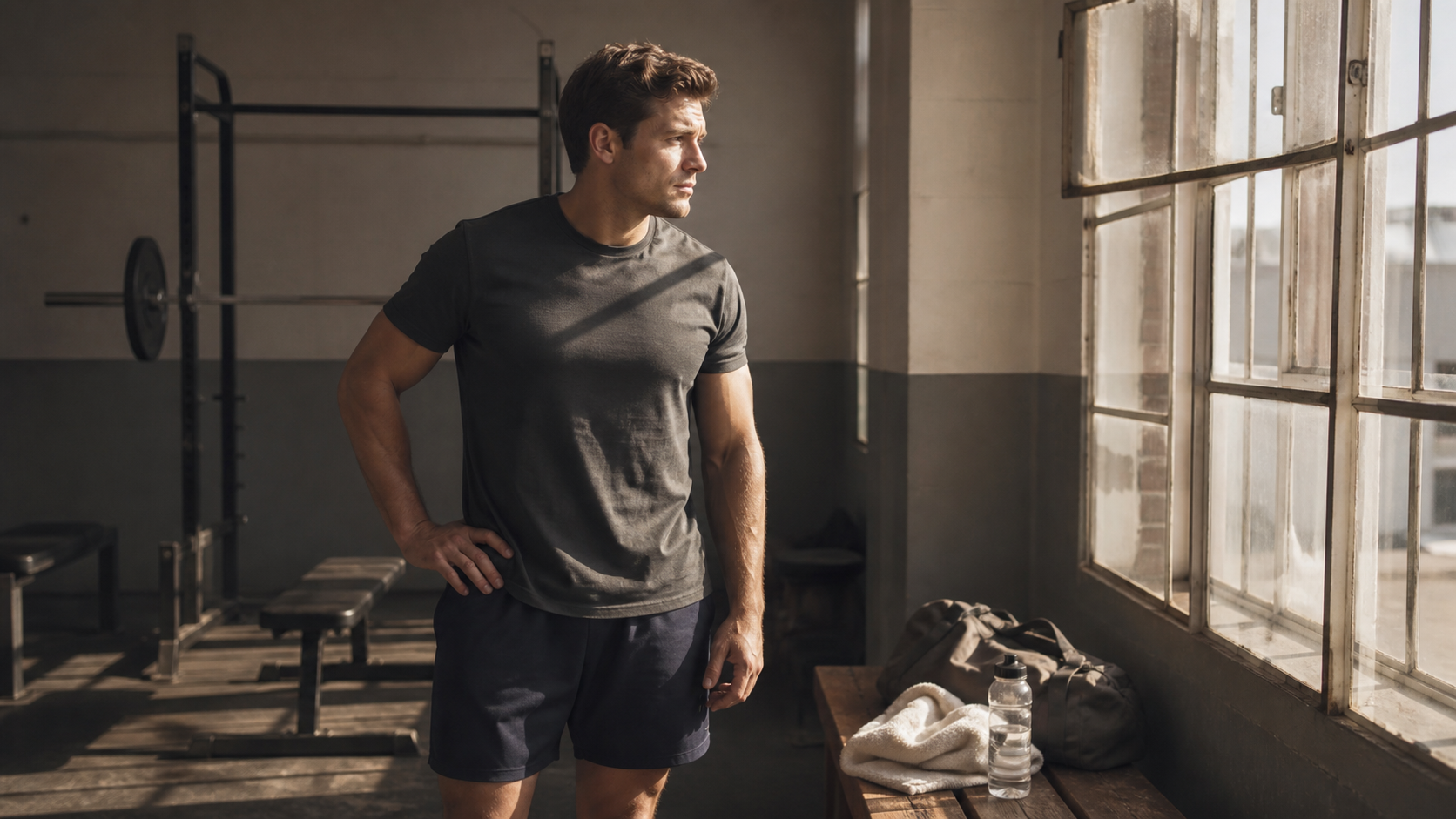
You finish a hard workout, hear that testosterone rises afterward, and assume the session must have been especially anabolic. Then a poor night’s sleep makes you wonder whether you have undone the benefit. The reality is more useful: testosterone responds to training, energy balance, body composition, health, and recovery, but a temporary change in blood does not automatically change how much muscle or strength you gain.
The Number Is Not the Outcome
Testosterone matters to male health, but treating it as a scoreboard confuses three things: a brief fluctuation, a lasting change in resting levels, and an actual improvement in performance or body composition.
A hard resistance or interval session can briefly raise circulating testosterone. After high-intensity interval training, the increase is generally gone within about 30–60 minutes [2]. That is a normal acute response, not a higher baseline.
The size of this spike does not appear to predict adaptation. In 56 young men completing 12 weeks of resistance training, acute free-testosterone responses were not associated with lean-mass or leg-press gains [3]. A review of 11 randomized trials also found essentially no average effect of training on resting total testosterone in healthy, insufficiently active men [1]. Fitness can improve without a higher baseline.
Pursue progressive overload, appropriate volume, specificity, and recovery. Do not choose exercises or rest periods simply for a larger hormone response.
Energy Balance Has More Influence
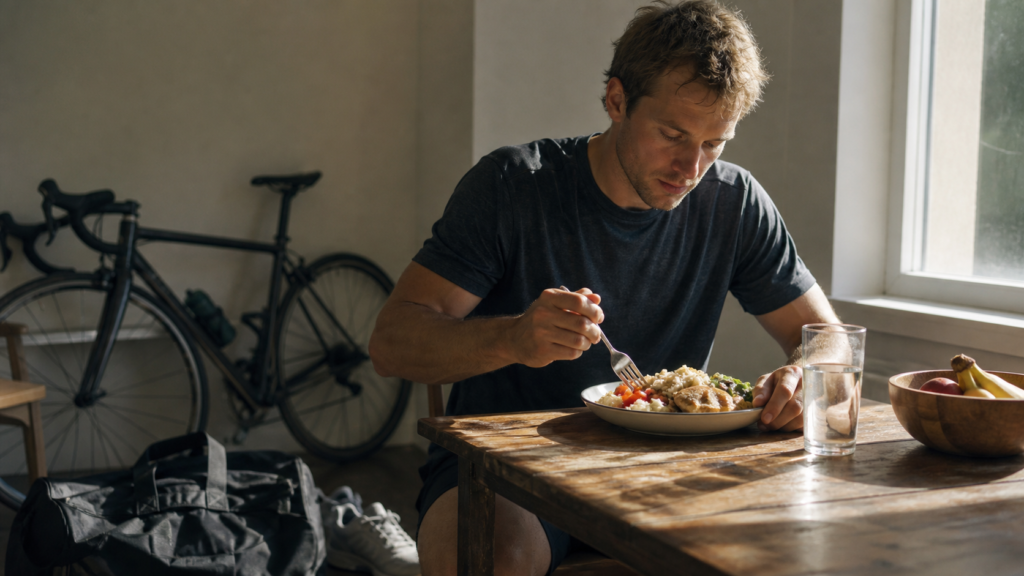
Among modifiable factors, the strongest evidence concerns body fat and energy availability.
Men with overweight or obesity commonly have lower total testosterone. This partly reflects lower sex hormone-binding globulin, or SHBG, but excess adiposity can also affect free testosterone and the hormonal system connecting the brain and testes.
Weight loss tends to move testosterone in the opposite direction. A meta-analysis covering 44 studies and 1,774 men found increases in total and free testosterone after diet-induced or surgical weight loss, with larger changes among men who lost more weight or began with greater obesity [4]. A separate European cohort also found that testosterone tended to rise with weight loss and fall with weight gain, while individual variation was much larger than the average age-related change [14].
There is no formula for the rise per kilogram lost. Many studies were observational or uncontrolled, and bariatric surgery does not forecast the effect of modest lifestyle weight loss. Still, gradual fat loss is better supported than a hormone-boosting supplement.
The opposite extreme matters too. When a lean or highly active man combines aggressive calorie restriction with a heavy workload and inadequate recovery, the body may reduce reproductive function. This is part of relative energy deficiency in sport, or REDs: a wider pattern in which too little available energy compromises health and performance [5].
An eight-week military field study combining severe energy restriction, heavy exertion, and sleep loss reduced total testosterone by about 70%; most hormonal and body-composition markers recovered within two to six weeks [6]. This is not an ordinary cutting phase, but it shows that suppression can be substantial and reversible. No universal male calorie-per-kilogram threshold is validated.
During a demanding diet, watch performance, recovery, mood, libido, injuries, and unintended weight loss. Several worsening markers matter more than one isolated result.
Sleep Matters, but Not as a Hormone Hack
Sleep supports alertness, training quality, recovery, and safety. Its testosterone effect during ordinary short sleep is less certain.
Two small randomized crossover studies in healthy young men—27 participants total—found no consistent adverse testosterone change after short sleep [7]. They were too small to rule out modest or subgroup effects, but “more sleep guarantees higher testosterone” goes beyond the evidence.
Severe obstructive sleep apnea is different. An observational meta-analysis linked it with lower testosterone, though confounding and reverse causation remain possible [8]. Loud snoring, witnessed breathing pauses, or persistent daytime sleepiness deserve clinical assessment.
Diet, Alcohol, and Boosters
Dietary fat is often presented as a testosterone control dial, but evidence conflicts. Six small intervention studies suggested modestly lower testosterone on low-fat diets [9], while a larger 2025 analysis of 11 randomized trials found no significant difference [10]. The studies varied widely, and neither review showed that more fat improves strength or muscle growth.
Aim for an adequate, sustainable diet. Avoid extreme restriction, but do not raise fat intake solely to manipulate a lab value.
Chronic alcohol exposure is a clearer reason for caution. Across 21 studies, it was associated with lower total and free testosterone overall, although the size and direction of the relationship varied with exposure patterns and study design [11]. A temporary response after a small dose is not evidence that alcohol is anabolic, and alcohol can also harm performance and recovery through routes unrelated to testosterone.
Commercial “testosterone boosters” offer little reassurance. Across 52 studies covering 27 ingredients, most lacked convincing evidence; positive findings were generally small, population-specific trials [12]. No class has robust evidence for improving strength or muscle through higher endogenous testosterone in healthy men. Contamination, mislabeling, interactions, and excessive micronutrient doses add risk.

When a Low Result Deserves Attention
One low measurement is not a diagnosis. Testosterone varies with time of day, meals, stress, illness, energy balance, SHBG, and assay method.
The Endocrine Society recommends diagnosing hypogonadism only when compatible symptoms or signs occur alongside unequivocally and consistently low testosterone. Testing should use an accurate assay and include a repeat morning fasting total-testosterone measurement; free testosterone may be considered when appropriate [13].
This is relevant for men with persistent loss of libido, erectile symptoms, reduced spontaneous erections, unexplained fatigue, infertility, anemia, low bone density, or unexpectedly poor recovery together with a low result. A clinician can assess possible causes, including medications, obesity, sleep disorders, or pituitary and testicular disease. Self-prescribed testosterone is not a safe shortcut: exogenous testosterone can suppress sperm production and requires medical monitoring.
Practical Takeaways
For healthy recreational trainees, the priorities are simple:
- Program training for adaptation, not for a fleeting testosterone spike.
- If you carry excess body fat, use gradual fat loss that preserves training quality and lean mass; expect possible hormonal improvement, not a guaranteed number.
- If you are lean and training hard, avoid combining escalating volume with prolonged aggressive calorie restriction.
- Protect sleep for performance and recovery, and seek assessment when symptoms suggest sleep apnea.
- Do not increase dietary fat, drink alcohol, or buy boosters solely to raise testosterone.
- Treat persistent symptoms plus repeated low results as a clinical question, not a self-treatment project.
These conclusions apply mainly to recreationally active men without diagnosed endocrine disease. Men with confirmed hypogonadism or another medical condition need individualized clinical guidance.
Conclusion
Testosterone is influenced by real biological pressures, but most day-to-day fitness choices do not need to revolve around it. Sustainable body composition, enough energy for the workload, sensible recovery, and well-designed training matter more than acute spikes or supplement claims. The useful question is not whether a tactic nudges a hormone reading, but whether it reliably improves health, performance, or recovery.
Sources
- Effects of Exercise Training on Resting Testosterone Concentrations in Insufficiently Active Men: A Systematic Review and Meta-Analysis. Journal of Strength and Conditioning Research, 2021. https://pubmed.ncbi.nlm.nih.gov/35134000/ DOI: 10.1519/JSC.0000000000004146. PMID: 35134000.
- Acute effect of HIIT on testosterone and cortisol levels in healthy individuals: A systematic review and meta-analysis. Scandinavian Journal of Medicine & Science in Sports, 2021. https://pubmed.ncbi.nlm.nih.gov/34022085/ DOI: 10.1111/sms.13999. PMID: 34022085.
- Associations of exercise-induced hormone profiles and gains in strength and hypertrophy in a large cohort after weight training. European Journal of Applied Physiology, 2012. https://pubmed.ncbi.nlm.nih.gov/22105707/ DOI: 10.1007/s00421-011-2246-z. PMID: 22105707.
- Meta-analysis and construction of simple-to-use nomograms for approximating testosterone levels gained from weight loss in obese men. Andrology, 2024. https://pubmed.ncbi.nlm.nih.gov/37345263/ DOI: 10.1111/andr.13484. PMID: 37345263.
- 2023 International Olympic Committee’s (IOC) consensus statement on Relative Energy Deficiency in Sport (REDs). British Journal of Sports Medicine / International Olympic Committee, 2023. https://bjsm.bmj.com/content/57/17/1073 DOI: 10.1136/bjsports-2023-106994.
- Recovery of endocrine and inflammatory mediators following an extended energy deficit. Journal of Clinical Endocrinology & Metabolism, 2014. https://pubmed.ncbi.nlm.nih.gov/24423293/ DOI: 10.1210/jc.2013-3046. PMID: 24423293.
- Sleep restriction and testosterone concentrations in young healthy males: randomized controlled studies of acute and chronic short sleep. Sleep Health, 2019. https://pubmed.ncbi.nlm.nih.gov/31416797/ PMID: 31416797.
- Association between obstructive sleep apnea and male serum testosterone: A systematic review and meta-analysis. Andrology, 2022. https://pubmed.ncbi.nlm.nih.gov/34536053/ DOI: 10.1111/andr.13111. PMID: 34536053.
- Low-fat diets and testosterone in men: Systematic review and meta-analysis of intervention studies. Journal of Steroid Biochemistry and Molecular Biology, 2021. https://pubmed.ncbi.nlm.nih.gov/33741447/ DOI: 10.1016/j.jsbmb.2021.105878. PMID: 33741447.
- The Effect of Low-Fat Diets Versus High-Fat Diet on Sex Hormones: A Systematic Review and Meta-Analysis of Randomized Controlled Trials. Journal of Food Science, 2025. https://pubmed.ncbi.nlm.nih.gov/40387562/ DOI: 10.1111/1750-3841.70266. PMID: 40387562.
- The chronic alcohol consumption influences the gonadal axis in men: Results from a meta-analysis. Andrology, 2024. https://pubmed.ncbi.nlm.nih.gov/37705506/ DOI: 10.1111/andr.13526. PMID: 37705506.
- Do “testosterone boosters” really increase serum total testosterone? A systematic review. International Journal of Impotence Research, 2023. https://pubmed.ncbi.nlm.nih.gov/37697053/ DOI: 10.1038/s41443-023-00763-9. PMID: 37697053.
- Testosterone Therapy in Men With Hypogonadism: An Endocrine Society Clinical Practice Guideline. Journal of Clinical Endocrinology & Metabolism / Endocrine Society, 2018. https://www.endocrine.org/clinical-practice-guidelines/testosterone-therapy DOI: 10.1210/jc.2018-00229.
- Age-associated changes in hypothalamic-pituitary-testicular function in middle-aged and older men are modified by weight change and lifestyle factors: longitudinal results from the European Male Ageing Study. European Journal of Endocrinology, 2013. https://pubmed.ncbi.nlm.nih.gov/23425925/ DOI: 10.1530/EJE-12-0890. PMID: 23425925.